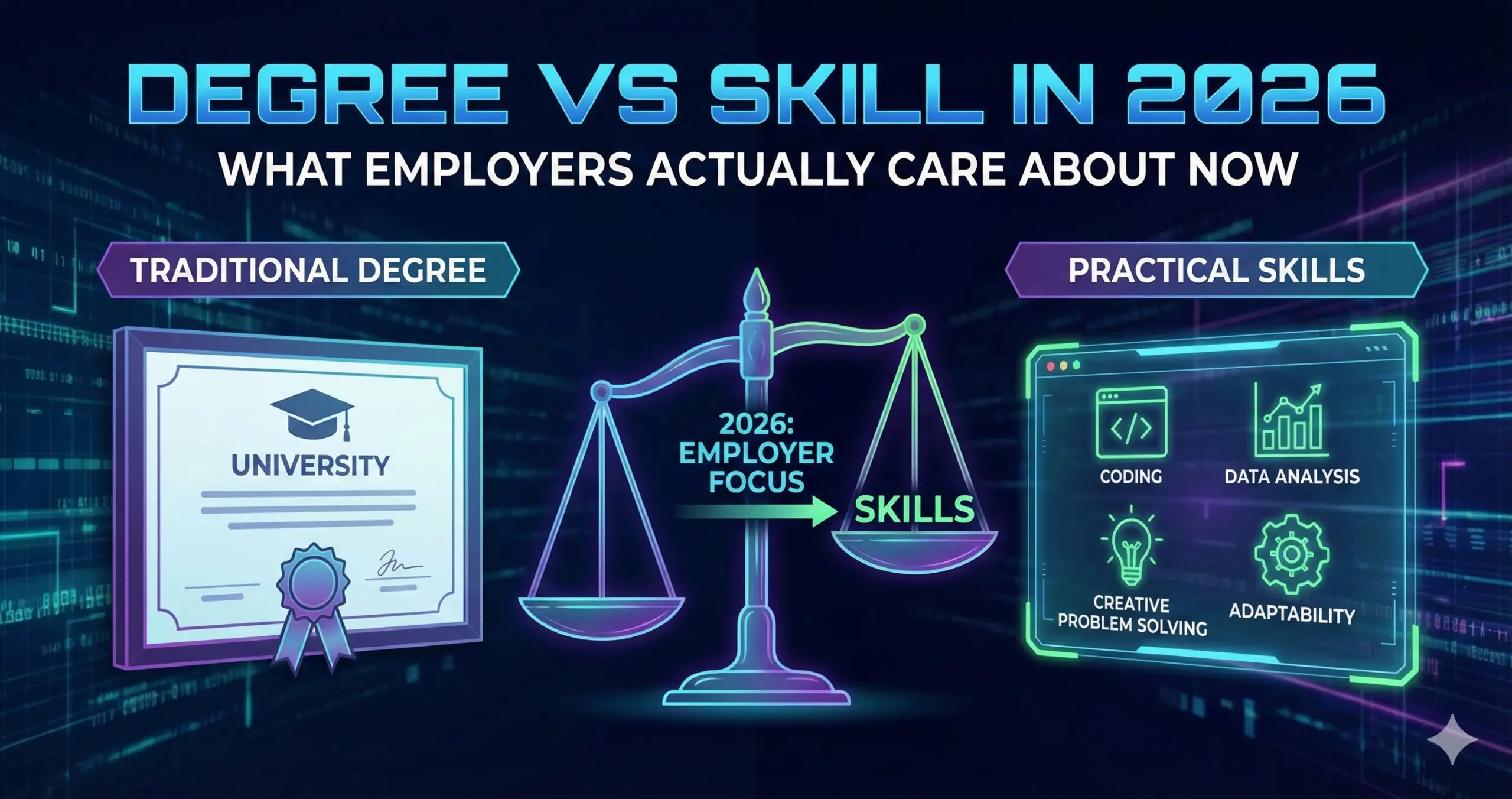
2026 is just around the corner, and a new generation of professionals is preparing to start their careers. But before taking the leap, many of them are asking an important question: in today’s world, what matters more—degree or skill? To address this, I’ve shared my perspective on the topic: Degree vs Skill in 2026 — What Employers Actually Care About Now.
Is a college degree still the safest path to a good job in 2026? This question is no longer Imaginary. You can see this type of questions are asking in student forums, HR panels, LinkedIn debates, and even inside companies themselves.
In 2026, hiring decisions look very different from what they did even five years ago. Now, employers are under pressure to hire faster, reduce training costs, and get measurable output quickly. That pressure has changed what they value most.
In 2026, most employers prioritize job-ready skills over formal degrees. This is especially in fast-moving sectors like technology, digital marketing, analytics, design, and AI.
However, degrees still matter for regulated professions, but they are no longer enough on their own. Now, companies look for proof of ability like projects, portfolios, problem-solving, and continuous learning. The most employable candidates have foundational education with demonstrable i.e. up-to-date skills.
Degree vs Skill in 2026: What Employers Actually Care About Now
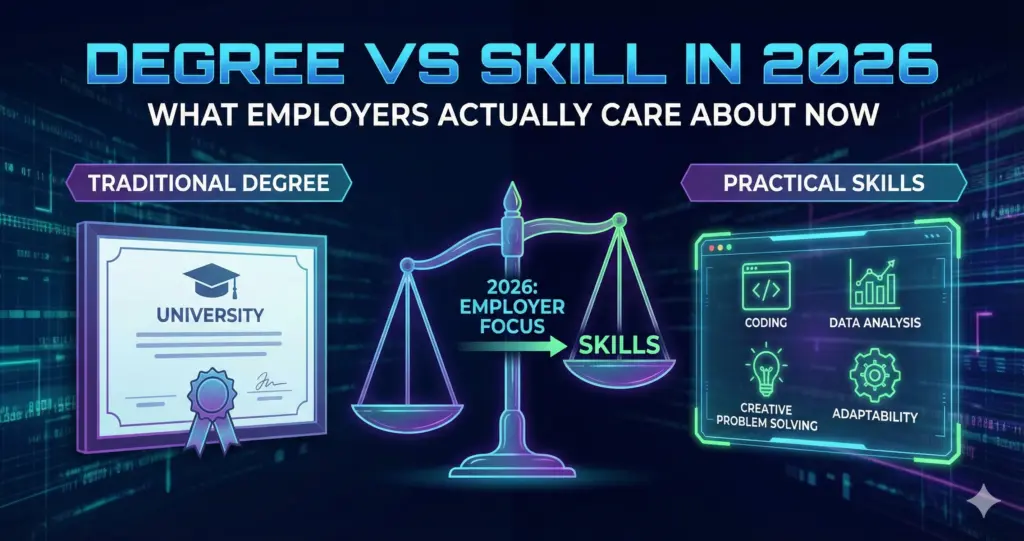
Why are so many employers openly moving away from degree-first hiring?
The uncomfortable truth is that many degrees no longer guarantee readiness for real work. Employers repeatedly report the same issue: graduates know concepts but struggle with execution. But, candidates without formal degrees having hands-on experience are delivering results immediately. This is the reason many employers openly moving away from degree-first hiring.
Another point you can think at this junction.
What matters more to employers: education or experience?
Obviously, in 2026, experience usually wins because it lowers risk. Hiring managers want someone who has already solved similar problems, not someone who promises they will learn and do later.
When companies say “skills,” what are they actually looking for?
Today, skills are specific, visible, and testable—they’re not vague traits listed on a resume. As a result, employers want to see what you can actually do, not just what you’ve studied. This makes it easier to understand what companies are truly looking for now.
What skills are most in demand in 2026?
As per my study, across industries, employers repeatedly prioritize:
- Applied technical skills (AI tools, automation, data handling)
- Problem-solving in real scenarios
- Communication in remote or hybrid teams
- Learning speed and adaptability
- Tool fluency, not tool familiarity
These skills translate directly into productivity, which is why they matter so much.
Which jobs care more about skills than degrees right now?
There are many jobs that value skills more than degrees, and I’ve highlighted some of them below for you to explore.
- Software development and AI roles
- Digital marketing and SEO
- UX/UI and product design
- Content strategy and media
- Data and business analytics
In these fields, employers usually ask for work samples before asking where you studied.
So why do degrees still matter at all?
Degrees haven’t disappeared because they still serve as trust filters. In high-risk or highly regulated professions, employers need standardized proof that a person meets baseline competency. That’s why degrees continue to matter in these fields. Some of them are highlighted below for your convenience.
- Medicine and healthcare
- Law and legal services
- Core engineering disciplines
- Government and public-sector roles
- Academic and research careers
In these paths, skills differentiate candidates but degrees still open the door.
Do employers still value degrees in 2026?
Yes—particularly in the above give fields.
My topic is Degree vs Skill in 2026: What Employers Actually Care About Now, and I’m addressing every key question related to it to give you the most complete picture possible. My goal is to ensure you find all the answers you’re looking for in one place. With that in mind, let’s move further.
How has the actual hiring process changed?
Hiring is now more practical and less ceremonial. Many companies test candidates before trusting resumes. Just like…
- Practical assignments or simulations
- Paid trial projects
- Portfolio reviews
- Structured problem-solving interviews
- Freelance-to-full-time conversions
These methods reveal far more than academic scores ever could.
Does this mean getting a degree is a waste of time?
No—but believing a degree alone guarantees success is a mistake in 2026. A degree without applied skills often leads to slow career starts and stalled growth. It is worth it when it:
- Builds strong fundamentals
- Is paired with internships or real projects
- Helps with visas, compliance, or career mobility
- Is treated as a base, not a finish line
The market no longer rewards passive education.
What role has AI played in shifting employer priorities?
AI didn’t just automate tasks—it also exposed major skill gaps. Professionals who can adapt, learn new tools quickly, and think critically are thriving, while those who rely solely on past credentials are finding it harder to keep up. So, What skills does AI-era hiring favor?
- Prompt design and tool integration
- Judgment and decision-making
- Systems thinking
- Ethical reasoning
- Continuous reskilling
These are learned through doing, not memorization.
Are online certifications actually respected now?
Yes—but only when backed by proof. Employers have become better at spotting certificate collectors versus capable professionals. They help when they:
- Are project-based
- Stay current
- Are supported by visible outcomes
- Align clearly with a role
Certificates amplify skills; they don’t replace them.
It’s important to note that several related aspects connect directly to the main topic, Degree vs Skill in 2026: What Employers Actually Care About Now. These connected points are discussed below, and I encourage you to go through them. They will help you understand today’s perspective more clearly, especially when comparing degrees and skills.
What should students and professionals do differently going forward?
Career planning in 2026 requires intention, and relying on a degree to “work its magic” is no longer realistic. In the meantime, focus on building one strong skill stack, practicing publicly whenever possible, learning in short cycles, treating feedback as fuel, and using education strategically rather than emotionally. Employers reward relevance, not nostalgia.
Degree vs Skill in 2026: A brief comparison that offers a quick, clear analysis of what employers truly care about in 2026.
| Factor | Degree-First Path | Skill-First Path |
|---|---|---|
| Time to employability | Slower | Faster |
| Cost | High | Flexible |
| Adaptability | Limited | High |
| Hiring preference | Traditional sectors | Modern industries |
| Career resilience | Moderate | Strong |
This explains why hybrid candidates dominate hiring outcomes.
What do employers value more in 2026—degree or skill?
The answer is – Employers value results. They want people who can learn, adapt, and deliver consistently. Degrees still matter, but skills determine growth, salary, and longevity. In 2026, the best answer is not either-or it’s intentional balance. Degrees may open doors, but skills decide how far you go inside.
Final thought on Degree vs Skill in 2026: What Employers Actually Care About Now
The insights shared above on Degrees vs Skills are based on the information I’ve gathered through research and study across various sources. The future belongs to professionals who stop asking, “Is my degree enough?” and instead start asking, “Can I solve real problems today?” That mindset—not the credential—is what employers value most now.
If you found this useful, please share it with others and consider subscribing to my blog. Your feedback is always appreciated.
Related:- परिक्षा पे चर्चा 2026 गाइड: अंतिम तिथि, पात्रता और आवेदन प्रक्रिया की पूरी जानकारी
Frequently Asked Questions
1. Do employers prefer degrees or skills in 2026?
In 2026, most employers prioritize skills over degrees, especially in fast-changing fields like technology, digital marketing, data, and design. Degrees still matter, but they no longer guarantee employability without demonstrated abilities.
2. Are degrees still necessary for getting a job?
Degrees remain essential in regulated professions such as medicine, law, government services, and core engineering. However, many modern jobs now hire based on practical skills and real-world experience rather than formal education alone.
3. Can I get a high-paying job without a degree in 2026?
Yes. Many high-paying roles—such as software development, AI operations, UX/UI design, content strategy, and digital marketing—focus on portfolio, performance, and experience, not degrees.
4. What skills are most demanded by employers today?
Employers in 2026 seek:
- Digital and AI literacy
- Analytical and problem-solving abilities
- Tool proficiency (automation, data tools, AI platforms)
- Communication and collaboration in hybrid teams
- Adaptability and quick learning
5. Do online certifications count in hiring decisions?
Yes, when they are practical, updated, and backed by real projects. Certifications alone aren’t enough, but they strengthen your profile when paired with hands-on work or a portfolio.
6. Why are employers shifting toward skill-based hiring?
Because skill-based hiring reduces training time, lowers hiring risks, and aligns better with the fast-paced, AI-driven job market. Employers want professionals who can perform immediately, not just understand concepts.
7. Is a degree useless if I focus on skills?
Not at all. A degree provides credibility, foundational knowledge, and long-term career security. Skills provide employability and adaptability. The strongest candidates combine both.
8. How does AI influence the value of degrees and skills?
AI has exposed skill gaps by automating routine tasks. Employers now look for people who can adapt, learn new tools, and apply critical thinking—attributes learned through practice, not just classroom education.
9. What is the best approach for students starting their career in 2026?
Build a core skill stack, create visible work (projects, internships, portfolios), learn continuously, and treat your degree as a foundation rather than your entire value. Employers reward relevance, not just credentials.
10. Which is better for long-term career growth: degree or skills?
Skills fuel short-term employability, while degrees support long-term stability in certain fields. But in 2026, adaptability and continuous learning matter more than either one alone. The ideal path is a combination of both.



![Study Abroad in 2025: Complete Roadmap for Indian Students [Timeline + Checklist]](https://knowledgehubforall.com/wp-content/uploads/2025/08/study-abroad-in-2025_-complete-roadmap-for-indian-students-timeline-checklist-2-scaled-200x100.jpg)