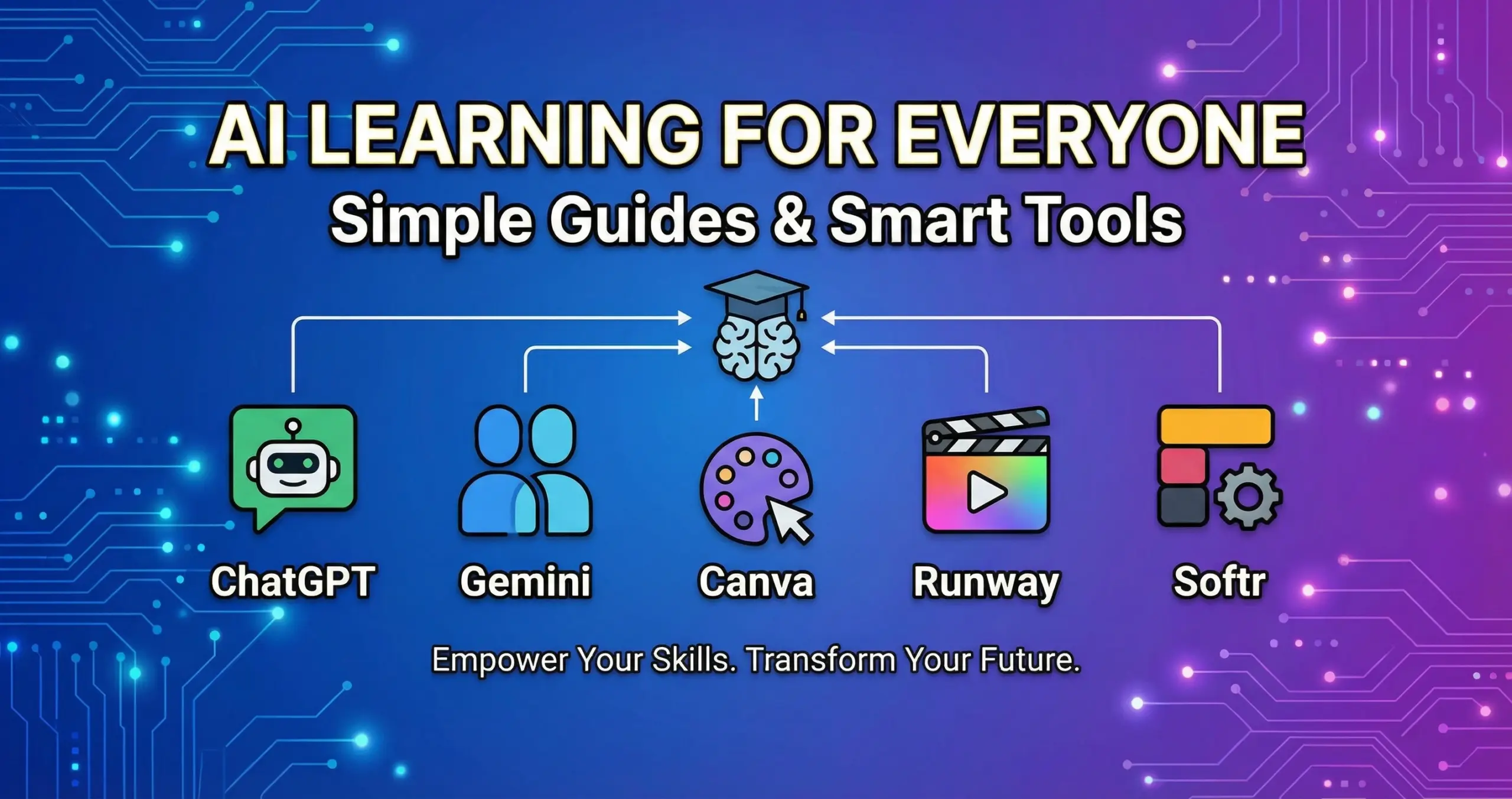
AI learning for everyone is no longer a future dream. It is the present reality reshaping how students, professionals, and creators acquire digital intelligence. In this comprehensive guide, “AI Learning for Everyone: Simple Guides & Smart Tools,” we break down the modern AI learning ecosystem, the no-code revolution, accessible platforms, and the tools making AI mastery achievable for anyone, regardless of technical background.
AI learning has become universally accessible in 2025 due to no-code tools, intuitive interfaces, prompt engineering frameworks, and low-cost learning resources. Anyone can start with foundational courses like Elements of AI, build skills using Google AI Essentials or DeepLearning.
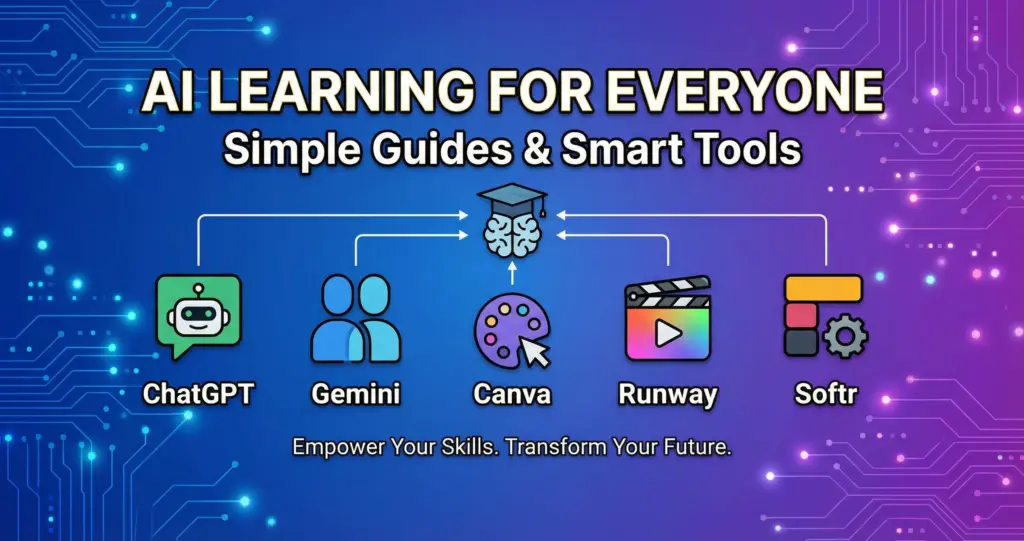
AI, and apply them through tools like ChatGPT, Gemini, Canva, Runway, and Softr. This democratized ecosystem supports students, entrepreneurs, and professionals through hands-on labs, community learning, answer engines, and agentic AI systems. It makes intelligence usable without programming expertise.
So stepping in details..
AI Learning for Everyone: Simple Guides & Smart Tools (2025 Guide)
SECTION 1 — The Educational Landscape Has Shifted Toward Accessible AI Learning
Why is AI Learning Becoming Easier for Everyone in 2025?
AI learning became dramatically more inclusive because platforms now prioritize clarity over complexity. Universities, tech companies, and independent experts redesigned AI courses to focus on conceptual understanding, user-friendly tools, and real-world workflows instead of coding or advanced math.
1.1 University Initiatives Form the Conceptual Foundation of AI Learning
Why do universities still play a crucial role in non-technical AI education?
Because academic programs teach the “why” behind AI systems—logic, ethics, search algorithms, and neural network fundamentals—helping learners understand how AI really works.
The University of Helsinki’s Elements of AI remains the global standard for beginners, while Wharton’s AI for Business teaches leaders how to manage AI ROI, risk, and strategy. These programs establish trust, depth, and E-E-A-T credibility in the AI literacy journey.
1.2 Big Tech Certifications Make AI Skills Immediately Practical
How do Google, Microsoft, IBM, and AWS make AI learning job-ready?
These platforms offer fast, industry-validated AI courses that focus on real tools rather than theory. Google AI Essentials trains learners in applied generative AI; Microsoft’s Learning Hub builds role-specific AI mastery; IBM and AWS emphasize enterprise-grade ethics, governance, and ML workflows. These certifications create a direct pathway from learning to employability.
1.3 Independent Platforms Accelerate Community-Driven Learning
Where can beginners learn AI skills quickly without university enrollment?
Learners flock to DeepLearning.AI, LinkedIn Learning, and Udemy for flexible micro-courses that update instantly after the release of new AI tools. Platforms like Andrew Ng’s AI For Everyone define the non-technical AI learning experience, while LinkedIn Learning delivers fast, tool-based tutorials aligned with current industry trends.
SECTION 2 — Prompt Engineering Becomes the Core Skill of AI Literacy
Why is prompt engineering now considered the “new coding”?
Prompt engineering allows anyone to control LLMs using natural language. Today’s frameworks transform prompting from a guessing game into structured, reproducible workflows.
2.1 Structured Prompt Frameworks Replace Guesswork
What is the most effective beginner-friendly prompting method?
The Role–Task–Tone framework is the most widely recommended prompting system: assign a role, define the task, specify tone or output format.
Combined with Zero-Shot, Few-Shot, and Chain-of-Thought prompting from LearnPrompting.org, users gain a reliable method to communicate clearly with LLMs across tasks.
2.2 AI Literacy Games Build Ethical Awareness and Critical Thinking
How can learners understand AI limitations safely?
Gamified tools like Two Truths & AI teach media literacy, while Gandalf by Lakera.ai simulates prompt injection attacks, helping users understand that LLMs predict patterns. They don’t store secrets like databases. These tools strengthen ethical judgment and security awareness.
SECTION 3 — Text-Based AI Tools Are the Core of the Modern Learning Toolkit
Which AI models dominate text generation and research in 2025?
The Big Three LLMs—Gemini, ChatGPT, and Claude—serve as the universal foundation for writing, research, and analysis.
3.1 Generalist LLMs Offer Distinct Strengths for Different Needs
Which AI model should beginners start with?
Gemini is best for long-document analysis, ChatGPT is the most versatile for learning and conversation, and Claude offers the highest-quality writing. Using multiple models builds better literacy and helps users compare reasoning styles.
3.2 Answer Engines Replace Traditional Search for Students & Professionals
Why are students switching from Google Search to Perplexity AI?
Because answer engines synthesize research, cite sources, and break queries into sub-problems automatically. Tools like Perplexity Pro, SciSpace, and Consensus offer academic-level insights without unreliable web noise.
3.3 Document Interaction Tools Transform How People Study and Work
How do tools like NotebookLM reduce hallucinations?
NotebookLM grounds answers in user-provided documents only, ensuring 100% source accuracy. Tools like ChatPDF allow learners to interrogate PDFs, extract insights, and generate summaries instantly.
SECTION 4 — Generative Media Tools Make Creativity Accessible
How do AI visual and audio tools empower non-designers?
AI tools now generate images, videos, audio, and designs with simple prompts—no advanced editing skills required.
4.1 Image Generators Balance Ease and Control
Which AI image tools are best for beginners?
Canva Magic Media is easiest for everyday use. Midjourney delivers artistic excellence. Adobe Firefly offers copyright-safe outputs for commercial use.
4.2 AI Video Tools Deliver Cinematic Results Without Skills
How are Runway, Sora, and Veo changing video production?
Runway gives fine control over motion, Sora produces high-consistency physics-aware scenes, and Veo enables long-duration clips with realistic continuity—reshaping education, marketing, and entertainment.
4.3 AI Audio & Music Tools Democratize Production
How can beginners create voiceovers or background music instantly?
ElevenLabs produces natural voiceovers, while MusicGen generates royalty-free music from simple text prompts—making creative production accessible to everyone.
SECTION 5 — No-Code and Low-Code Tools Let Anyone Build Apps
Why is no-code development the biggest shift in AI-enabled productivity?
No-code tools give non-programmers the ability to build apps, workflows, and automations previously requiring dedicated developers.
5.1 AI App Builders Convert Ideas Into Real Applications
How do tools like Softr and Glide build apps from a spreadsheet?
You describe the app, connect a data source, and AI generates layouts, logic, and UI automatically. Tools like Gamma generate presentations instantly from text descriptions.
5.2 Automation Platforms Build AI-Driven Workflows
Why is Zapier Canvas considered a game-changer?
It visualizes complex workflows like mind maps. AI can auto-generate entire processes: lead capture → summary → email → Slack notification—no coding required.
5.3 ML Tools Teach Hands-On AI Fundamentals
How does Teachable Machine help beginners understand machine learning?
It visually demonstrates how models learn patterns, biases, and features—using only a webcam. Edge Impulse extends this to IoT and hardware-based ML.
SECTION 6 — Students Access Powerful AI for Free
How do free student programs accelerate AI adoption?
Student-exclusive benefits provide thousands of dollars’ worth of tools at zero cost.
6.1 GitHub Student Developer Pack Remains the Most Valuable Bundle
Why is Copilot free for students such a big deal?
It gives learners a real-time AI coding tutor, along with cloud credits and premium educational platforms—all free.
6.2 Education-Focused Tools Bridge Opportunity Gaps
Which AI tools are free for schools and colleges?
Perplexity Pro, Canva for Education, and Notion Plus offer full-featured tools to students and teachers, democratizing access regardless of budget.
6.3 Academic Integrity Evolves Due to AI Tools
How are schools adapting to AI-written content?
They are shifting toward oral exams, project-based evaluation, and AI-assisted learning rather than relying solely on essays or detection tools.
SECTION 7 — Community Platforms Become the New Classrooms
Why is community learning essential in a rapidly changing AI world?
AI evolves weekly, making live communities more valuable than static textbooks.
7.1 Discord Powers Social Learning in AI
How is Midjourney’s community accelerating creative learning?
Users see prompts and results shared openly, helping everyone learn visual prompting techniques through real-time experimentation.
7.2 Skool Communities Teach Practical Earning Skills
Why are AI automation communities booming?
They offer templates, workflow blueprints, and step-by-step methods to build AI automation agencies without technical experience.
7.3 AI Newsletters Serve as Knowledge Filters
Which AI newsletters are best for staying updated?
The Rundown AI and Ben’s Bites summarize the fast-moving AI landscape daily and provide curated learning opportunities.
SECTION 8 — Hands-On Security Labs Teach Real AI Vulnerabilities
How do learners understand AI safety through playful tools? (PAA)
Security games and hands-on labs reveal AI’s weaknesses in a safe, controlled environment.
8.1 Gandalf Teaches Prompt Injection Through Gameplay
Why must every AI learner understand prompt injection?
To avoid misusing or exposing sensitive data. Gandalf teaches this through increasingly strict levels that simulate real-world vulnerabilities.
8.2 Hugging Face Spaces Offers Instant ML Experiments
Why are Spaces important for AI literacy?
Because learners can test ML models instantly without installations—bridging the gap between academic papers and practical usage.
SECTION 9 — Future Trends Reveal AI’s Next Transformation
How will AI learning continue evolving beyond 2025?
The next wave focuses on agentic systems, workflow mastery, and personal multipliers.
9.1 Intelligence Becomes a Commodity
Why do interfaces and workflows matter more than the AI model?
Because all major models are powerful; the differentiator is usability. The future belongs to tools that make AI intuitive, not complex.
9.2 Agentic AI Becomes the New Productivity Layer
What is agent orchestration and why is it important? (PAA)
It’s the skill of managing autonomous AI workers that research, write, monitor, and automate tasks proactively.
9.3 The “Polymath of One” Becomes Possible for Every Individual
How can one person produce end-to-end creative and technical work?
AI amplifies individuals with writing, coding, designing, composing, and automation tools—removing barriers between imagination and execution.
Conclusion AI Learning for Everyone: Simple Guides & Smart Tools (2025 Guide)
AI learning is now accessible, inclusive, and empowering. Through foundational courses, structured prompting, answer engines, creative AI, no-code tools, security labs, and agentic systems, anyone can become AI-fluent. AI Learning for Everyone: Simple Guides & Smart Tools is not only a trend—it has become the new digital literacy standard of 2025.
Frequently Asked Questions
What is AI Learning for Everyone: Simple Guides & Smart Tools?
AI Learning for Everyone: Simple Guides & Smart Tools describes the democratized AI education ecosystem where students, professionals, and creators learn AI without coding, using no-code platforms, prompt frameworks, and beginner-friendly tools like ChatGPT, Gemini, Canva, Runway, and Softr.
How can beginners learn AI without coding?
Beginners can take courses like Elements of AI, Google AI Essentials, and DeepLearning.AI’s AI For Everyone, which emphasize conceptual understanding, prompting skills, and practical applications rather than programming or advanced math.
What are the best AI tools for beginners in 2025?
Top beginner tools in 2025 include ChatGPT, Google Gemini, Claude, Canva Magic Media, Runway Gen-4, ElevenLabs, Perplexity AI, Softr, Glide, and Teachable Machine for writing, research, design, automation, and hands-on learning.
What is prompt engineering and why is it important?
Prompt engineering is the practice of crafting clear, structured inputs for AI models; it’s crucial because it directly impacts the relevance and accuracy of AI outputs. Common frameworks include Role–Task–Tone, Zero-Shot, Few-Shot, and Chain-of-Thought.
What are the top AI courses for beginners?
Recommended beginner courses include Elements of AI, Google AI Essentials, DeepLearning.AI’s AI For Everyone, Microsoft AI Learning Hub, IBM Introduction to AI, and AWS Machine Learning Foundations, covering concepts, ethics, and workflows.
How do AI answer engines like Perplexity help students?
Answer engines break queries into sub-questions, summarize sources, and provide citations, delivering structured, research-backed answers faster than traditional search engines; some offer student discounts or free Pro access.
What are the best no-code tools for building AI-powered apps?
Softr, Bubble, Glide, and Gamma are top no-code tools that use AI to generate interfaces, map data, and build automations, enabling non-technical users to create apps and portals quickly.
How does Canva help beginners use AI for design?
Canva’s Magic Media integrates AI image, text, and video generation into a drag-and-drop interface, enabling professional-looking designs for education, marketing, and small businesses without prior design skills.
How do AI video tools like Runway and Sora work for creators?
Runway Gen-4, Luma Dream Machine, Google Veo, and OpenAI Sora enable creators to produce high-quality video from text prompts or images by simulating motion, lighting, and temporal consistency, reducing the need for traditional filming.
What is the future of AI learning and agentic AI?
The future includes agentic AI—autonomous systems that perform tasks like research, email triage, and CRM updates. Learning will shift toward orchestrating these agents and designing secure, ethical workflows.
Related:-