
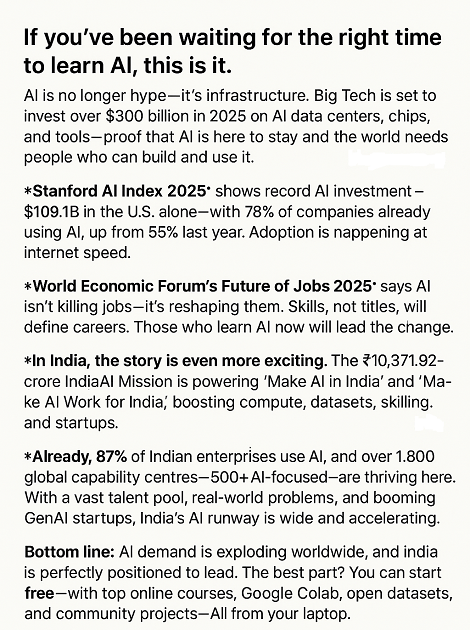
If you’ve been waiting for the right time to learn AI, this is it. AI is no longer hype, it’s infrastructure.
Big Tech is set to invest over $300 billion in 2025 on AI data centers, chips, and tools. It is proof that AI is here to stay, and the world needs people who can build and use it.
The Stanford AI Index 2025 shows record AI investment- $109.1 billion in the U.S. alone. And also, 78% of companies are already using AI, up from 55% last year. Adoption is happening at internet speed.
The World Economic Forum’s Future of Jobs 2025 says AI isn’t killing jobs, it’s reshaping them. Skills, not titles, will define careers. Those who learn AI now will lead the change.
In India, the story is even more exciting. The ₹10,371.92-crore IndiaAI Mission is powering “Make AI in India” and “Make AI Work for India,” boosting compute, datasets, skilling, and startups.
Already, 87% of Indian enterprises use AI, and over 1,800 global capability centres, 500+ AI-focused, are thriving here. With a vast talent pool, real-world problems, and booming GenAI startups, India’s AI runway is wide and accelerating.
Bottom line: AI demand is exploding worldwide, and India is perfectly positioned to lead. The best part? You can start free—with top online courses, Google Colab, open datasets, and community projects—all from your laptop.
What You’ll Get
- First: decide your why (career change? side-project? curiosity?).
- Then: start with free foundational AI courses (Python + basics of ML).
- Next: apply what you learn via small hands-on projects.
- After that: build a portfolio (GitHub, Kaggle, etc.).
- Finally: connect with the AI community and explore specialised tracks (NLP, computer-vision, generative AI).
- All this can be done from India, largely for free thanks to platforms and government initiatives.
- Key is: consistency + practice > chasing “perfect” certificate.
Now, let’s move into how to structure this, what resources to pick, what mindset you need, and how to make it India-specific.
Why AI is a Great Choice Right Now
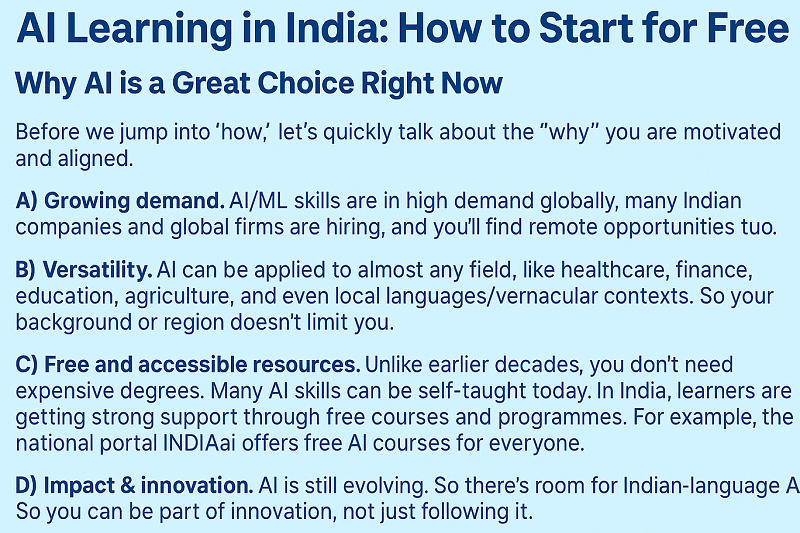
Before we jump into “how”, let’s quickly talk about the “why” you are motivated and aligned.
A) Growing demand. AI/ML skills are in high demand globally, many Indian companies and global firms are hiring, and you’ll find remote opportunities too.
B) Versatility. AI can be applied to almost any field, like healthcare, finance, education, agriculture, and even local languages/vernacular contexts. So your background or region doesn’t limit you.
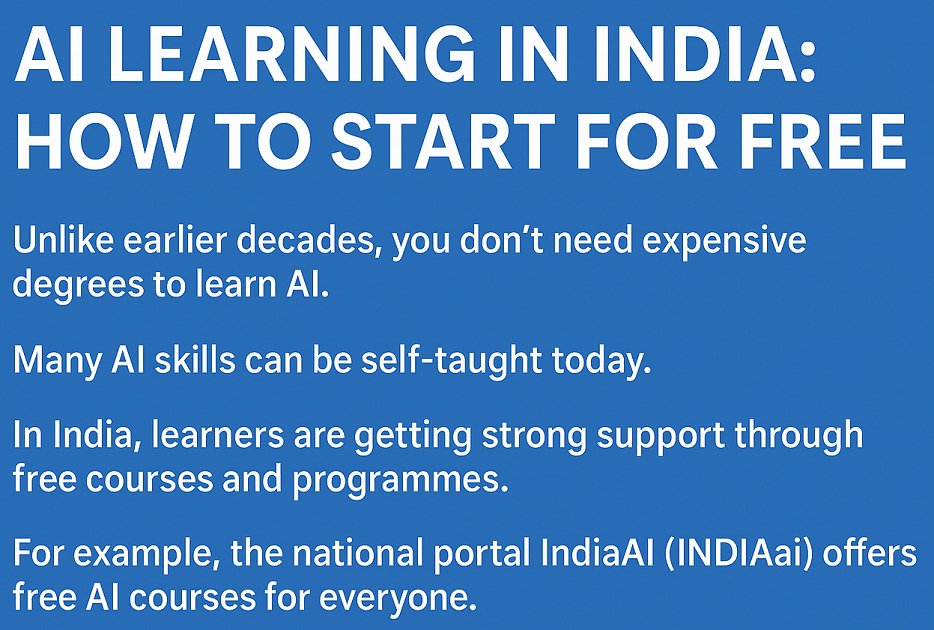
C) Free and accessible resources. Unlike earlier decades, you don’t need expensive degrees. Many AI skills can be self-taught today. In India, learners are getting strong support through free courses and programmes. For example, the national portal INDIAai offers free AI courses for everyone.
D) Impact & innovation. AI is still evolving. So, there’s room for Indian-language AI. So you can be part of innovation, not just following it.
Let’s move!
AI Learning in India: How to Start for Free
Step-by-Step Guide to Start Learning AI for Free in India
Here I’ll walk through five phases of your AI learning journey: Preparation, Foundations, Hands-On Practice, Specialisation, Application & Community.
For each phase, I’ll cover what to do, why it matters, resources (free), and tips to get the most out.
Phase 1: Preparation – Setting Your Groundwork
What to do:
- Decide why you want to learn AI. Is it for a job shift? Starting a side project? Research? This will shape how you prioritise.
- Make sure your basic infrastructure is ready: a laptop/PC, internet connection (since lots of video courses). In India, sometimes you might face bandwidth or power constraints, so plan accordingly (download lectures when possible, use scheduled study).
- Set realistic time commitments. For example: 5–7 hours/week for the first 2 months.
- Pick a programming language to learn (Python is the default in AI).
- Clean your mental map: anyone can learn AI. You don’t need to be a math genius, but you do need to be willing to learn math, statistics, and code, and keep practicing.
Why it matters:
If you jump straight into advanced topics without preparation, you’ll likely get stuck, frustrated, or give up. So, getting the foundations of your mindset, time management, and tools ready is crucial.
Free resources:
- The “Introduction to Artificial Intelligence” free online course: DeepLearning.AI (via Coursera), etc.
- The national portal INDIAai’s learning section: offers free ML courses using Python.
- Google’s “Learn Essential AI Skills” free modules.
Tips:
- If you’re in a region with spotty internet, download content, watch offline.
- Use a free code editor like VS Code and set up Python environment early.
- Keep a notebook (digital or physical) of what you’re learning — helps retention.
- Set micro-goals: e.g., “By end of week 1 I’ll understand ‘What is AI?’, types of AI, history of AI”.
- Join a study-buddy or small online group (you can find India-based Slack/Telegram groups) to keep yourself accountable.
Phase 2: Foundations – Mathematics, Python & Core Concepts
What to do:
- Learn Python basics: variables, functions, data structures, libraries like NumPy, Pandas.
- Learn basic mathematics/statistics: linear algebra, calculus (very basic), probability, statistics — these underpin machine learning.
- Get introduced to core AI/ML concepts: supervised vs unsupervised learning, neural networks, deep learning, natural language processing (NLP), computer vision.
- Work through tutorials and small exercises so that you’re comfortable reading code and writing simple models.
Why it matters:
- Without this foundation you’ll struggle when you reach deeper subjects. Think of it as building your “AI engine” before you plug in fancy modules like generative AI.
Free resources:
- Free AI courses offered in India: for example the “Free Artificial Intelligence (AI) Courses” listing by Great Learning Academy covers Python libraries, ML, deep learning.
- The course “An Introduction to AI” by Reaktor & University of Helsinki (ElementsofAI) is global and free.
- NVIDIA’s “AI Learning Essentials” hub gives modules on AI fundamentals.
- On the Indian side, the national “AI for All” programme makes AI accessible to the Indian public.
Tips:
- Don’t rush through math. If you find linear algebra or probability challenging, spend time—use Khan Academy or Indian YouTube channels to revisit.
- Write code daily (even 20–30 minutes) rather than binge once a week. Consistency wins.
- Try simple projects: e.g., load a dataset (Iris dataset, even Indian-data like student performance) and perform basic ML classification.
- Use GitHub to store your code (makes it easier for future portfolio).
- Document what you do: blog short posts or simple comments in code. Helps your “authoritativeness” later.
Phase 3: Hands-On Practice – Real Projects & Skills Application
What to do:
- Choose small projects you care about. For example, predict something with Indian data (weather, stock, cricket analytics, language classification, Hindi text sentiment analysis).
- Use open datasets (Kaggle, government portals) and attempt an end-to-end pipeline. collect/clean data → build model → evaluate → document results.
- Explore frameworks/libraries: Scikit-learn, TensorFlow/Keras, PyTorch.
- Try version control (Git), basic deployment (maybe deploy model on free cloud or even locally).
- Build your portfolio (GitHub), blog/tweet about your process, show your results.
Why it matters:
- Theory is fine but AI is best learnt by doing. Hands-on projects build intuition, teach you “what doesn’t work” (which is as important as “what works”), and make you credible.
Free resources:
- The free AI courses listed above include practical components (e.g., Great Learning’s free course emphasises hands-on).
- The national portal INDIAai has learning pages and links to projects.
- In India, you’ll also find multidisciplinary free courses, e.g., IIT Madras (via SWAYAM) launched five free AI courses, such as “AI/ML using Python”, “Cricket analytics with AI”, “AI in Physics”, etc.
Tips:
- Pick one project you finish fully before moving to many half-done ones. Finishing is key.
- Document mistakes and lessons learned (your blog, README).
- Share your project on LinkedIn or in India-based GitHub community. You’ll build “trustworthiness” in your personal brand.
- Try to use Indian context/data if possible — this sets you apart (e.g., Indian languages, Indian farmer dataset, cricket dataset).
- Use free computing resources: Google Colab gives free GPU support (good for DL).
- Track your time. Further, allocate perhaps a “project weekend” every two weeks.
Phase 4: Specialisation – Choose Your Niche & Build Depth
What to do:
- Once you have the basics and a project or two, choose a niche: e.g., NLP (Indian languages), computer vision, generative AI (LLMs, image generation), reinforcement learning, AI for social good (education, agriculture).
- Further, study deeper topics: advanced machine learning algorithms, deep learning (CNNs, RNNs), transfer learning, prompt engineering, generative models (GANs, LLMs).
- Take advanced free courses, and follow research papers (at a manageable pace. In addition, get comfortable reading academic material and writing your own small-scale “paper style” report of your project.
- Build further projects in your niche (e.g., build a Hindi text summariser, or a model to classify crop types via satellite imagery).
- Optionally get a free certificate if available (it’s nice but not the most important part). The credibility comes from skills + portfolio + communication.
Why it matters:
- The AI field is vast. So doing a little of everything will get you so far. Going deeper in one area helps you be “good” at something rather than “okay” at many. Recruiters, collaborators, and research groups often prefer people who can show depth.
Free resources:
- Coursera/DeepLearning.AI: Many AI specialisations you can audit for free (you may skip certificate if cost is involved) — e.g., “AI for Everyone”, machine learning specialisations.
- Google AI/Google Learn AI Skills: Introduction to large language models etc. Free modules.
- NVIDIA free courses/training.
Tips:
- Choose your niche because you enjoy it — this will help sustain motivation.
- Set a “challenge” for yourself: e.g., build and publish a small blog or YouTube video explaining your project. Teaching is a great way to build authority and trust.
- Start reading recent papers (use summaries, YouTube explainer videos when needed).
- Participate in competitions (e.g., Kaggle) in your niche area to test your skills under pressure.
- Network: reach out to local meet-ups, AI clubs in Indian tech hubs (Bangalore, Hyderabad, Delhi) or online India-based AI communities.
Phase 5: Application, Portfolio & Community – Make It Count
What to do:
- Build a portfolio of at least 2-3 completed projects that show your ability end-to-end (data → model → results → explanation).
- Write a blog (Medium, Dev.to, your own site) about your AI journey, your niche, your projects. This builds your “expertise, authoritativeness, trustworthiness” (EAT) online.
- Share your work: GitHub repos, LinkedIn posts, local Indian tech forums.
- Stay connected to community: join Indian AI/ML groups, attend free webinars, hackathons.
- Apply your learning: maybe intern with a startup, or volunteer to build an AI solution for a non-profit. Even unpaid work builds experience.
- Keep learning: AI evolves fast; generative models, MLOps, prompt-engineering are hot. Stay updated.
- Consider credentialing (if you want) — but only after you’ve built experience. Free certificates are fine; paid ones only if they add clear value.
- Explore local Indian contexts: multilingual AI, rural applications, Indian regulatory/fairness/ethics issues. These are under-served and a chance to differentiate.
Why it matters:
- Having skills is one thing; making them visible and meaningful is another. Employers/research collaborators look for evidence of what you’ve done. Also, you’ll feel more confident when you have a voice in the community.
Free resources & tips:
- Use GitHub Pages (free) or a free blog (Medium) to publish.
- Many Indian webinars/hackathons are free — keep an eye on event listings (INDIAai portal, Meetup.com).
- Follow Indian-specific AI news, initiatives: e.g., the Government of India training hundreds of thousands in AI.
- If you want, you can take free government-supported AI courses (for example the ones by IIT Madras on SWAYAM platform).
- Document your story: “Here’s how I learned, here’s the project I built, here’s what I found”—this becomes your personal brand.
Additional tip for Indian context:
- Make sure your LinkedIn profile and GitHub have at least a short “About me” in English (and optionally in Hindi or your native language) — this helps recruiters in India.
- Use India-time relevant learning schedules: for example, choose study slots when internet is better (late evenings if needed).
- Leverage free cloud credits if available in India (Google, AWS, Microsoft often have education programmes).
- Keep track of cost-free vs paid: many Indian courses offer free auditing; pay only if you need certificate and it brings clear benefit.
- Think about cost of certifications: India has some free certificate courses, but many paid ones may cost ₹ tens of thousands — do cost-benefit before enrolling.
Common Pitfalls & How to Avoid Them
Because you asked for “valuable content”, here are things many people stumble on—and how you can avoid them.
- Pitfall: Jumping too fast to advanced topics
- You see “Generative AI”, “GPT-4”, “Deep Reinforcement Learning” and you skip fundamentals. Then you struggle.
- Fix: Make sure you are comfortable with basics (Python + ML + basic models) before diving. Use the first two phases.
- Pitfall: Learning in isolation with no project
- Watching videos endlessly but never applying.
- Fix: Commit to a project early (e.g., finish one project within 4 weeks). Use “learn-then-apply” cycle.
- Pitfall: Not documenting or sharing your work
- You build something, but it sits on your machine. No GitHub, no blog, no link.
- Fix: Upload every project on GitHub, write at least one summarising blog post: “What I did”, “What I learned”, “Next steps”.
- Pitfall: Getting certificate-obsessed
- Paying money or chasing dozens of certificates rather than doing projects.
- Fix: Focus on skills first, certificate later. Certificates may help but they don’t replace real practice.
- Pitfall: Neglecting community and soft skills
- AI is not just about code; communication, storytelling, domain-knowledge matter.
- Fix: Practice explaining your projects to a non-tech audience, write blogs, contribute to discussions, maybe mentor someone. This builds trustworthiness.
- Pitfall: Burn-out or dropping off
- Learning AI is a marathon, not a sprint. Many start enthusiastically and then fade.
- Fix: Set realistic time, work in chunks, celebrate small wins (finishing a notebook, completing a project), keep variety (switch between reading, code, blog).
- Use local peer group for accountability.
How to Structure Your 12-Month Plan
Here’s a sample plan you could adopt (flexible, adjust to your time). This helps you see the full picture.
| Month | Focus | What to accomplish |
|---|---|---|
| 1–2 | Preparation & Foundations | Learn Python basics, basic math/stats; complete one free intro course. |
| 3–4 | Foundations continued | Learn ML fundamentals, do simple models with Scikit-learn; complete one small dataset project. |
| 5–6 | Hands-On Practice | Choose your first “real” project (Indian dataset), complete end-to-end, upload GitHub, write blog. |
| 7–8 | Choose Niche & Specialisation | Pick your niche (e.g., NLP for Indian languages); take advanced modules; start second project. |
| 9–10 | Portfolio & Community | Finish second project, share it widely; attend webinars/hackathons; network. |
| 11–12 | Deepen & Apply | Build third project (maybe deploy it or collaborate with others); reflect on your learning; prepare your profile/resume for job/side-opportunity. Add a section on ethics/responsible AI (important in India). |
This timeline is just a guide — you might move faster or slower. The key is to finish what you start and keep iterating.
Free Resources – Summary Table (India-Friendly)
Here’s a quick summary of good free resources you can use:
| Platform / Resource | What you get | Notes for India |
|---|---|---|
| Great Learning Academy – Free AI Courses | Basics of AI, Python, ML, with certificate. | Certificates may be free/donation-based; check current terms. |
| IndiaAI portal – Learning section | Free courses on ML using Python, and AI resources for India. | Focuses on Indian context as well. |
| Google – Learn AI Skills / Grow with Google | Free modules, badges. | Good for global context; free without fees. |
| NVIDIA – AI Learning Essentials / Free Courses | Advanced modules, developer-level. | Might require more computing power; use free GPU platforms. |
| ElementsofAI (global) | Free intro to AI (non-technical) for everyone. | Great for non-CS background; gives broad overview. |
Tips when choosing a resource:
- Make sure it’s self-paced or has times you can keep up.
- Check if you need to pay for certificates (you can skip that if you don’t need it).
- Prioritise resources that allow hands-on labs or code, not just lectures.
- Use Indian time zone/community if possible (some global platforms may have hard deadlines or timeslots not ideal for India).
- Combine one global resource + one India-focused resource to get both broad and local relevance.
What’s Next & What to Avoid
Next steps for you right now:
1. Pick one free introductory AI course (e.g., from Great Learning Academy or IndiaAI portal) and commit to start within the next 48 hours.
2. Set up your Python environment (install Anaconda or Python3, VS Code).
3. Choose your first micro-project: maybe “Classify sentiment of Hindi movie-reviews” or “Predict crop yield using Indian dataset” — something you’re interested in.
4. Reserve 5–7 hours/week for the first month and mark in your calendar.
5. Join one online community (Telegram/Slack/Facebook group) for Indian AI learners so you have peer support.
6. At the end of each week write a short summary of what you learned (makes you accountable).
What to avoid:
- Don’t buy a pricey “AI certificate course” without checking reviews or whether you’ll actually complete it.
- Don’t compare yourself too harshly to experts; stay beginner-friendly and grow step by step.
- Avoid trying to cover “everything” at once — pick one path and deepen it.
- Don’t skip documentation—your code + blog are your future employability evidence.
- Avoid stagnation: if you find yourself “just watching videos” for a month with no project, stop and restart differently.
Final Thoughts on AI Learning in India: How to Start for Free
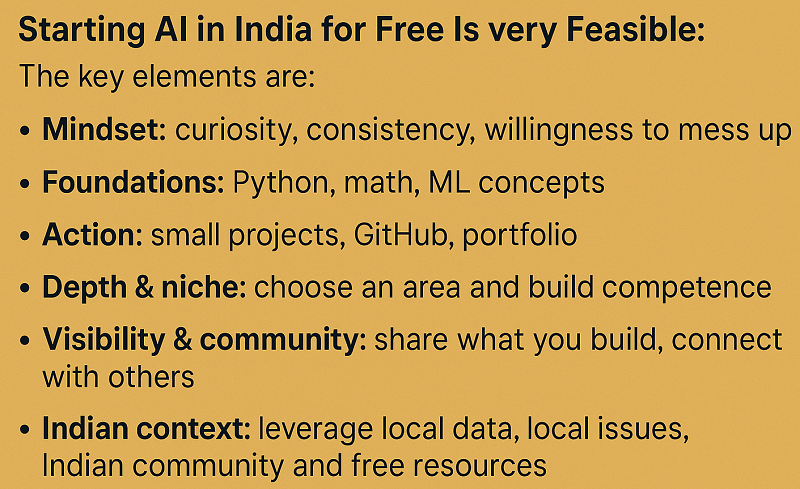
Starting AI in India for free is very feasible. The key elements are:
- Mindset: curiosity, consistency, willingness to mess up.
- Foundations: Python, math, ML concepts.
- Action: small projects, GitHub, portfolio.
- Depth & niche: choose an area and build competence.
- Visibility & community: share what you build, connect with others.
- Indian context: leverage local data, local issues, Indian community and free resources.
Your learning journey will build expertise (you’ll know AI fundamentals and build models), authoritativeness (you’ll show your work and speak about it), and trustworthiness (you’ll document your journey, be transparent about what you’ve done). These three — often referred to as E-A-T in SEO and content strategy — matter not just for content/blogs but for how you present yourself as an AI practitioner.
If you keep learning regularly, within 12 months, you could reach a point where you can confidently build small, real-world AI projects. You might even start working with others or apply for internships or jobs. And the best part — you’ll achieve this with little or no money spent.
What do you think? 💭 Drop your thoughts in the comments and hit ❤️ if you agree!
You may like to read:-
What Are Digital Skills? A Beginner’s Guide for Students and Professionals
Top 30 Digital Tools and Platforms Every Freelancer Must Use
Frequently Asked Questions
How do I start learning AI for free in India?
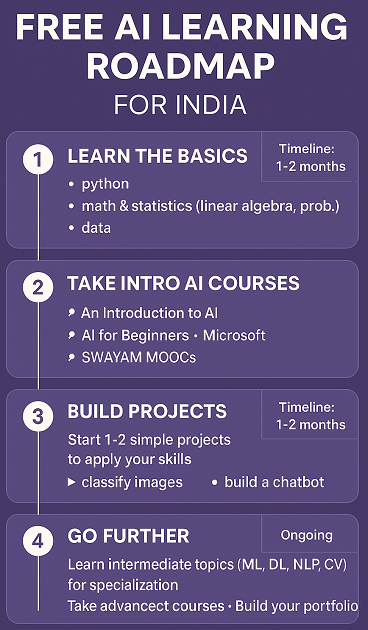
First build foundational skills: learn basic programming (e.g., Python), mathematics (especially linear algebra, probability/statistics) and data handling.
Then pick a free beginner-friendly AI/ML course. For example:
An Introduction to AI (free, non-technical) from Elements of AI.
AI for Beginners (12-week curriculum) from Microsoft.
Free course listings (IBM, Google, Microsoft) for beginners.
Use Indian government portals: SWAYAM offers MOOCs (massive open online courses) free or low-cost.
Set a learning plan with timeline, resources and goals.
Tip: Pick one small project (for example: “classify images” or “build a chatbot”) to apply what you’re learning — this helps retention and builds your portfolio.
What are the prerequisites (skills/knowledge) I need before starting?
You don’t need to be an expert, but having these helps:
- Comfort with programming (Python is highly recommended).
- Basic mathematics and statistics: linear algebra, probability, distributions.
- Understanding of data structures, how data is stored & accessed.
- Ability to learn/experiment: go through tutorials, do mini-projects, learn from mistakes.
Tip: If you find the math tough, you can start with very simple “no-code” AI/ML resources, then gradually build up the stronger foundation.
Which free online courses/platforms are available to learn AI in India right now?
Here are some good ones:
- Elements of AI (“An Introduction to AI”) – free and global.
- Microsoft’s “AI for Beginners” curriculum – free.
- Google’s “Learn AI Skills” page – free modules.
- Indian platform SWAYAM – free MOOCs across topics, including AI.
Tip: Most free courses offer “audit” mode (free to learn, certificate may cost). If certificate is important to you, check certificate cost.
How long will it take to become competent in AI?
It depends on many factors (prior skills, time you dedicate, your goal). General guidance:
- 3 months: if you already know programming & math, you could gain a solid foundation.
- 6-12 months: if you are starting fresh (little programming/math), to become comfortable with ML, some deep-learning, and build a portfolio.
- Beyond a year: specialization (NLP, computer vision, deployment), deeper research, advanced topics.
Tip: Consistency is key — small daily or weekly learning beats sporadic long sessions. Build small projects along the way.
What kinds of jobs or opportunities can AI learning open up in India?
Learning AI can open various career paths, such as:
- Machine Learning Engineer, Data Scientist, AI Engineer
- AI Product Specialist, AI Analyst
- AI roles in business: “AI for business processes”, automation, analytics
- Freelancing / building AI-powered applications or startups
Also, since many industries (finance, healthcare, manufacturing, and education) in India are adopting AI, there is an increasing demand for people with AI skills.
Tip: To make yourself job-ready:
Understand domain (how AI is applied in your area: e.g., marketing, healthcare)
Work on real-world projects (even simple ones)
Show up in your resume/portfolio: “I built X using ML/AI”
Learn tools/frameworks (e.g., scikit-learn, TensorFlow, PyTorch)





I have observed that car insurance companies know the autos which are susceptible to accidents and other risks. Additionally they know what form of cars are given to higher risk plus the higher risk they’ve got the higher the premium amount. Understanding the simple basics involving car insurance just might help you choose the right sort of insurance policy that will take care of your family needs in case you become involved in any accident. Thank you for sharing the actual ideas on your own blog.