
The rules of the workplace have changed forever. Digital skills are no longer just about “using a computer” or sending emails; they are now about surviving and succeeding in an AI-integrated workplace.
In fact, the gap between the “tech-savvy” and the “tech-illiterate” is widening faster than ever due to rapid automation and the adoption of new tools.
Whether you are a student trying to future-proof your career or a professional fighting to stay relevant, this shift impacts you. To succeed in this new era, you must move beyond basic literacy. You need digital literacy, AI fluency, and the ability to navigate workplace automation seamlessly.
What Are Digital Skills? A Beginner’s Guide for Students and Professionals
Key Takeaway: What “Digital Skills” Actually Mean in 2026
“Digital skills define the ability to find, evaluate, use, share, and create content using information technologies and the Internet. In 2026, this goes beyond typing and email; it now includes AI literacy, data interpretation, remote collaboration, and digital security. It is the combination of technical know-how and the critical thinking required to navigate a digital-first world effectively.”
What Are Digital Skills? (Definition & Distinction)
At its core, a digital skill is the ability to use technology to solve problems, not just consume content. Many people mistakenly believe that scrolling through social media makes them “digital natives,” but true digital proficiency is about productivity and outcome (result). To understand where you stand, it is crucial to distinguish between three commonly confused levels.
The “Big Three” Distinction:
- Digital Literacy: Can you use the internet safely and effectively? (e.g., Browsing, Search, Netiquette).
- Digital Skills: Can you use specific tools to do a job? (e.g., Excel, Zoom, CRM software, ChatGPT).
- Tech/IT Skills: Can you build the tools? (e.g., Coding, Cloud Architecture, Software Engineering).
What is the difference between digital skills and technical skills?
Digital skills focus on using technology effectively to perform tasks (like analyzing data in Excel), whereas technical or IT skills involve creating or engineering the technology itself (like writing the code for Excel). Most modern jobs require digital skills, but not all require deep technical skills.
Why Digital Skills Are Your Currency in the Job Market
Digital proficiency is the single biggest factor determining your employability today. Because industries like finance, healthcare, and education are undergoing rapid digital transformation, employers prioritize candidates who don’t need “hand-holding” with technology.
Why you cannot ignore this:
- The “Hybrid” Standard: 92% of jobs now require digital proficiency, even in traditionally non-desk roles like retail or logistics.
- Salary Impact: There is a direct correlation between digital skills and income; professionals with AI and data skills command significantly higher earning brackets.
- Adaptability: Software changes every year. Therefore, the ability to pivot and “learn how to learn” new tech is valuable.
Why are digital skills important for employability?
Digital skills are vital because they prove to employers that you can adapt to automation, collaborate across remote teams, and use data-driven tools to save the company time and money.
The 4 Pillars of Modern Digital Skills
To be truly “job-ready,” you need a balance of four specific skill sets. We have renamed these to reflect the Outcome (Natija) they produce in a real workplace.
1. Foundation & Communication (The Basics)
Everything starts here; without these, you are digitally invisible.
- Information Handling: Mastery of search engines and organized file management (Cloud storage).
- Professional Communication: Understanding Email etiquette and norms for platforms like Slack/Teams.
- Cybersecurity Awareness: Recognizing phishing, maintaining password hygiene, and understanding data privacy.
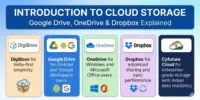
☁️ Stop Losing Your Files
True digital literacy means knowing how to access your work from anywhere. Are you still confused between Google Drive and Dropbox? You need to master the Cloud.
Read the Guide: Introduction to Cloud Storage ➤2. AI Fluency & Automation (The New Standard)
This is no longer an “advanced” skill; it is a baseline requirement.
- Prompt Engineering Basics: Knowing how to effectively talk to Large Language Models (LLMs) to get the best result.
- AI Drafting: Using AI tools for drafting emails, summarizing reports, and brainstorming.
- Task Automation: Setting up simple workflows to automate repetitive tasks (saving time).
⚡ Build Faster in the AI Era: Smart Website Creation
If you are mastering digital skills, the ultimate test is speed. Why code from scratch when you can use AI to bridge the gap between “idea” and “launch”?
Modern AI tools now allow you to:
- 🎨 Design Visually: Create layouts without technical friction or deep coding.
- ✍️ Draft Instantly: Use GPT-5 assistance to write compelling copy in seconds, saving hours of brainstorming.
- 🚀 Go Live Faster: Edit pages in real-time and publish with confidence—even as a beginner.
This is exactly how AI Fluency turns into a real-world Outcome (Natija).
Design, draft, and publish in just a few clicks.
Disclosure: Some links in this article are affiliate links. This means if you click through and make a purchase, I earn a small commission at no additional cost to you.
3. Creation & Productivity (Doing the Work)
This pillar is about the “Synergy” (Taalmel) between you and the software.
- Collaborative Clouds: Co-authoring documents in real-time using Google Workspace or Office 365.
- Digital Content: Basic visual design (Canva), video trimming, and engaging presentation design.
- Project Management: organizing tasks using tools like Trello, Asana, or Notion.
4. Data Literacy (Making Decisions)
You don’t need to be a data scientist, but you must understand the numbers.
- Spreadsheet Competency: Moving beyond simple sums to use Pivot Tables and VLOOKUP.
- Reading Dashboards: The ability to look at an analytics graph and understand the trend.
- Fact-Checking: Verifying sources to avoid spreading misinformation.
📈 From “Page Views” to “Revenue”: The B2B Edge
Getting traffic is only half the battle. True digital competence means converting those anonymous visits into real business leads. This is where Data Literacy creates a measurable Outcome (Result).
Many businesses struggle because they don’t know who is visiting their site. 98% of visitors never fill out a form.
Modern B2B analytics tools solve this by helping you:
- 🎯 Identify the Company: See exactly which businesses are visiting your site (even if they don’t contact you).
- 🏢 Track Buyer Intent: Know what pages they looked at and for how long.
- 🔁 Automate the Lead: Sync qualified prospects directly to your CRM for the sales team.
Stop guessing. Move from “traffic data” to a “revenue pipeline” instantly.
See which companies are interested in you right now.
Digital Skills by Career Stage: Students vs. Professionals
The specific skills you need depend on where you are in your journey. While the tools might be the same, the objective (Maqsad) differs significantly.
For Students: The “Entry-Level” Toolkit
- Focus: Research validity, academic formatting, presentation tools, and building a professional digital portfolio (LinkedIn).
- Goal: To prove to employers that you are “trainable” and digitally literate.
For Professionals: The “Upskilling” Toolkit
- Focus: Workflow optimization, advanced data analysis, leading remote teams, and adopting new proprietary software quickly.
- Goal: To prove that you remain “relevant” and cannot be easily replaced by automation.
🚀 Don’t Let a Bad Resume Hide Your Digital Skills
Learning digital skills is only half the journey. The real challenge is presenting those skills clearly to employers. Many candidates miss opportunities not because they lack ability, but because their resume fails to communicate value.
AI-powered resume builders now solve this by helping you:
- 🧠 Translate Skills: Turn your experience into “job-ready” keywords that recruiters look for.
- 🤖 Beat the Bots: Create ATS-friendly formats that ensure your CV actually gets read by a human.
- 📄 Design Instantly: Produce professional, polished layouts in minutes—no formatting stress.
Join 4+ million users worldwide who use this platform to stand out in the job market.
Free to start. Customize and optimize in minutes.
Real-World Examples of Digital Skills at Work
Digital skills look different depending on the job role. Here is how they appear in daily scenarios:
- The Teacher: Using LMS platforms to track grades and AI tools to generate lesson plans.
- The Marketer: Analyzing social media metrics and running A/B tests on digital ads.
- The Admin: Using Excel macros to sort massive data sets and scheduling tools for logistics.
- The Retail Worker: Operating inventory management tablets and complex POS systems.
💸 Turn Digital Skills into Income: AI Commerce
Learning digital skills is valuable; however, applying them to generate a real Outcome (Result) matters even more.
For many beginners (especially in India and Europe), the biggest barrier to starting a business is “technical friction.” AI removes that barrier.
Modern AI-powered platforms now enable you to:
- 🎯 Auto-Find Winners: Identify profitable products automatically without hours of research.
- ✍️ Write Instantly: Generate SEO-optimized product descriptions using AI.
- 🛒 Build & Launch: Create a complete online store in minutes, not weeks—no coding required.
This is the perfect synergy of AI + Digital Entrepreneurship. Go from “idea” to “first sale” 10x faster.
🔥 Special Offer: Get 2 Months FREE with a Yearly Plan
Plans start at just €12.48/month—a practical entry point for beginners.
👉 Unlock the AI Store Builder Offer →“Digital Soft Skills”: The Hidden Requirement
Technology is useless if you cannot communicate with humans. These “soft” digital skills are often the deciding factor in promotions.
- Digital Empathy: The ability to read “tone” in text-based communication to avoid misunderstandings.
- Netiquette: Maintaining professionalism in Zoom calls (camera usage, muting) and instant messaging.
- Digital Wellbeing: Managing your screen time and focus in a deeply distracted world.
How to Learn Digital Skills
You do not need a degree to learn these; you need a “Single Window System” approach to learning.
- Step 1: Audit Yourself. Be honest—what do you not know? (e.g., “I am bad at Excel”).
- Step 2: Micro-Learning. Use free platforms like YouTube, Coursera, or LinkedIn Learning for short tutorials.
- Step 3: Certification. Validate your skills with recognized badges (e.g., Google Career Certificates, Microsoft Learn).
- Step 4: Application. Don’t just watch; do. Build a project or automate a real task.
How can I improve my digital skills for free?
You can improve your digital skills for free by utilizing YouTube tutorials, taking free courses on Coursera (audit mode) or edX, practicing with open-source software, and following tech experts on LinkedIn.
🛠️ Essential Toolkit for Beginners
Knowing the theory is important, but using the right software is what gets you hired. If you are ready to start practicing, you need the right set of tools.
Check the Top 30 Digital Tools & Platforms ➤(Perfect for freelancers, students, and remote workers)
Conclusion On What Are Digital Skills? A Beginner’s Guide for Students and Professionals: From “Digitally Literate” to “Digitally Fluent”
Building digital skills is no longer optional; it is a necessity for survival. However, remember that tools change. The app you use today might be gone tomorrow. The real skill is your adaptability—your willingness to open a new program and say, “I can figure this out.”
The technology will change, but the skill of adaptation remains yours to keep. Start small, but start today.
👉 Your Turn (CTA): Which digital skill are you currently struggling with—Excel, AI, or Video Editing? Let me know in the comments below, and I’ll share a free resource to help you!
Frequently Asked Questions
Which digital skill is most in demand in 2026?
AI Fluency and Data Analysis are currently the top two most requested skills across all industries.
Do I need to know how to code to have digital skills?
No. While coding is a technical skill, most digital skills (like CMS management or SEO) require no code knowledge.
How do I put digital skills on my resume?
Create a dedicated “Skills” section. List the software you know (e.g., “Proficient in Google Analytics”) rather than vague terms like “Computer Savvy.”
Is it too late to learn digital skills in my 40s/50s?
Never. Experience combined with new digital tools makes you a powerhouse. The learning curve might be steeper, but the value is immense.


you’re really a good webmaster. The site loading speed is amazing. It seems that you are doing any unique trick. Moreover, The contents are masterwork. you have done a fantastic job on this topic!