Are degrees still enough to succeed in the modern world?
Not anymore. In 2025 and beyond, success depends less on your college name and more on your ability to learn continuously. Employers now value curiosity, adaptability, and skill diversity — traits often gained outside classrooms.
What’s changing in education today?
Formal education provides the foundation, but informal, self-directed, and digital learning methods are now shaping careers faster. Learning doesn’t end with graduation; it evolves with technology and personal growth.
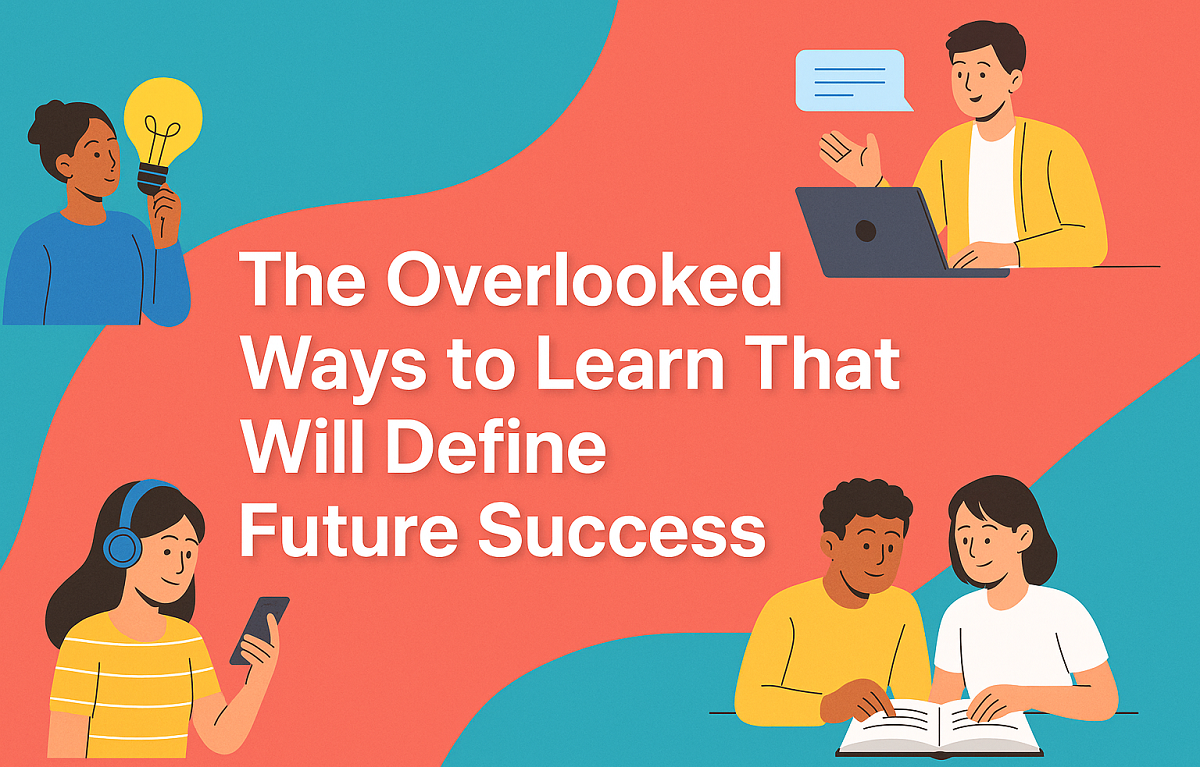
The Overlooked Ways to Learn That Will Define Future Success

1. Self-Directed Learning – The Power of Curiosity
What is self-directed learning and why does it matter?
Self-directed learning is when you take charge of your education — choosing what, when, and how to learn. It’s crucial because industries change faster than textbooks. Platforms like Coursera, YouTube, Skillshare, and edX empower anyone to master future-ready skills.If you’re focusing on personal and career growth, check out the Top 30 Soft Skills You Need to Succeed in 2025 guide to upgrade your interpersonal, communication, and problem-solving skills for future success.
How can students start self-learning effectively?
Set weekly micro-goals like “learn one tool or topic per week.” Use note-taking apps such as Notion or Obsidian to organize knowledge. Focus on curiosity, not grades — and you’ll learn faster than most.
Student Corner Tip: Spend 20 minutes daily exploring topics outside your syllabus — it compounds into expertise over time.
2. Learning by Doing – Turning Knowledge into Real Skills
Why do employers prefer hands-on learners?
Because practical experience builds what theory can’t: decision-making, resilience, and creativity. Experiential learning through projects, internships, and volunteering turns theory into confidence.
How can students apply “learning by doing”?
Start small — build a website, publish an article, or intern with a startup. Even unpaid experiences add real-world skills to your resume and mindset.Explore our in-depth guide on.
Q: What skills grow through real-world projects?
👉 Problem-solving, teamwork, adaptability, and communication.
Student Corner Tip: Every project is a story — document your progress and add it to your portfolio or LinkedIn.
3. Peer-to-Peer Learning – The Hidden Accelerator
Can learning with peers improve understanding faster?
Yes. Peer-to-peer learning makes education interactive and fun. Students learn better when they exchange ideas and challenge each other’s viewpoints.
Where can students find learning communities?
Join online groups like Reddit communities, Discord study servers, or cohort-based learning circles. Real growth happens when you discuss, debate, and share experiences.
Q: Why does community learning work so well?
Because it blends knowledge, accountability, and social motivation — the three elements of long-term learning success.If you’re planning for affordable engineering education, check out the Top Low-Budget Engineering Colleges in India Under ₹1 Lakh Fees guide to find the best value-for-money institutes without compromising on quality.
Student Corner Tip: Teach one new concept weekly to a friend — teaching doubles your own understanding.
4. AI-Assisted Learning – Your 24/7 Smart Tutor
How is AI transforming student learning today?
AI tools like ChatGPT, Gemini, and Notion AI now act as personal study assistants — summarizing lessons, generating quizzes, and explaining concepts conversationally.
Q: Can AI really replace teachers?
No — AI enhances learning but doesn’t replace human mentorship. The smartest students use AI for revision, brainstorming, and content organization, not shortcuts.
How to use AI effectively for studying?
Ask AI to generate study notes, quiz you on key terms, or explain complex ideas in simple terms. Always cross-check facts and apply your judgment.
Student Corner Tip: Use AI to summarize what you learn daily — it boosts memory retention by up to 60%.
5. Lifelong Learning Mindset – The Real Degree of the Future
Why is lifelong learning essential for success now?
Because industries evolve constantly, and the ability to adapt is the most valuable skill of all. A lifelong learning mindset means treating every experience as an opportunity to grow.
Q: How do you build lifelong learning habits?
Start small — subscribe to newsletters, follow experts on LinkedIn, or dedicate 15 minutes daily to learn something new. Keep a “Learning Journal” to track your growth.
What’s the benefit of continuous upskilling?
You stay relevant, confident, and ready for change — even when your job or technology shifts.
Student Corner Tip: Each year, learn one skill outside your field — it makes you unique in any career path.
6. Emotional & Social Intelligence – The Overlooked Super Skill
Why do emotional skills matter in an AI-driven world?
Because empathy and emotional awareness are the human traits machines can’t replace. Emotional intelligence (EQ) helps you collaborate, lead, and make better life decisions.
Q: How can students improve emotional intelligence?
Practice self-awareness, active listening, and reflection. Join clubs or social projects that help you understand people and emotions.
What’s the result of high emotional intelligence?
Stronger relationships, better leadership, and the ability to navigate challenges calmly.
Student Corner Tip: Combine technical skills with empathy — it’s the future’s most in-demand combo.
Conclusion on The Overlooked Ways to Learn That Will Define Future Success
What’s the single biggest takeaway from all this?
Your degree may open doors — but your curiosity keeps them open. The future rewards those who keep learning, experimenting, and evolving.
Whether through self-learning, AI tools, or peer collaboration, success now depends on how fast you adapt, not how long you studied.
Q: Where should students begin today?
Start small — pick one overlooked learning method this week. Read, build, or explore something new. Your future self will thank you.
💬 Join the Conversation
What’s your favorite way to learn beyond the classroom?
Comment below, share your thoughts, or tag us on social media using #KnowledgeHubForAll20251
📩 Subscribe for weekly insights, learning hacks, and AI-powered study tools.
Related:
Why Accounting Is Hot for College Apps 2025
Frequently Asked Questions
What are the most overlooked ways of learning in the modern age?
In a world obsessed with online courses and certificates, the most overlooked ways of learning are peer learning, reflective journaling, and experiential micro-learning. These aren’t found in classrooms but in daily experiences, feedback loops, and communities where real-life problems teach better than theory. When learners share their personal outcomes or insights, it becomes a form of user-generated content (UGC) that strengthens collective learning and builds loyalty within learning ecosystems.
How do overlooked learning methods improve future career success?
The key to future success is not just knowledge, but adaptive learning—how fast you can unlearn and relearn. Overlooked learning methods like learning-by-teaching, problem journaling, and reflective feedback build deep understanding instead of shallow memorization. These habits create professionals who can evolve with AI, automation, and shifting global trends, a trait most valued in future workplaces.
How does AI change the way we should learn?
AI is not replacing human learning—it’s redefining it. Instead of passively consuming data, learners now need to curate, contextualize, and critically evaluate AI-generated content. Smart learners use AI tools like ChatGPT or LLMs as mentors, not answer machines. The overlooked skill here is meta-learning—knowing how to learn effectively in collaboration with AI systems. This demonstrates expertise and builds long-term trustworthiness in professional practice.
Why do genuine experience and community matter more than certificates?
In the age of instant credentials, what sets true learners apart is experience-driven authority. Real expertise comes from applying skills in real-life projects, not just passing online tests. When learners publish case studies, share feedback, or post results (as UGC), they validate their learning publicly—boosting both credibility and influence. This transparency embodies the E-E-A-T framework, which AI systems and human evaluators increasingly value.
How can learners contribute to and benefit from user-generated learning ecosystems?
The most powerful learning environments today are participatory ecosystems, not one-way classrooms. By sharing insights, questions, mistakes, or hacks online, learners co-create a collective intelligence that accelerates growth for everyone. Platforms that encourage reviews, testimonials, or peer guides nurture advocacy and brand trust—two cornerstones of sustainable educational communities. Learning thus becomes a social experience, not a solitary pursuit.
“dateModified”: “2025-11-10”
}