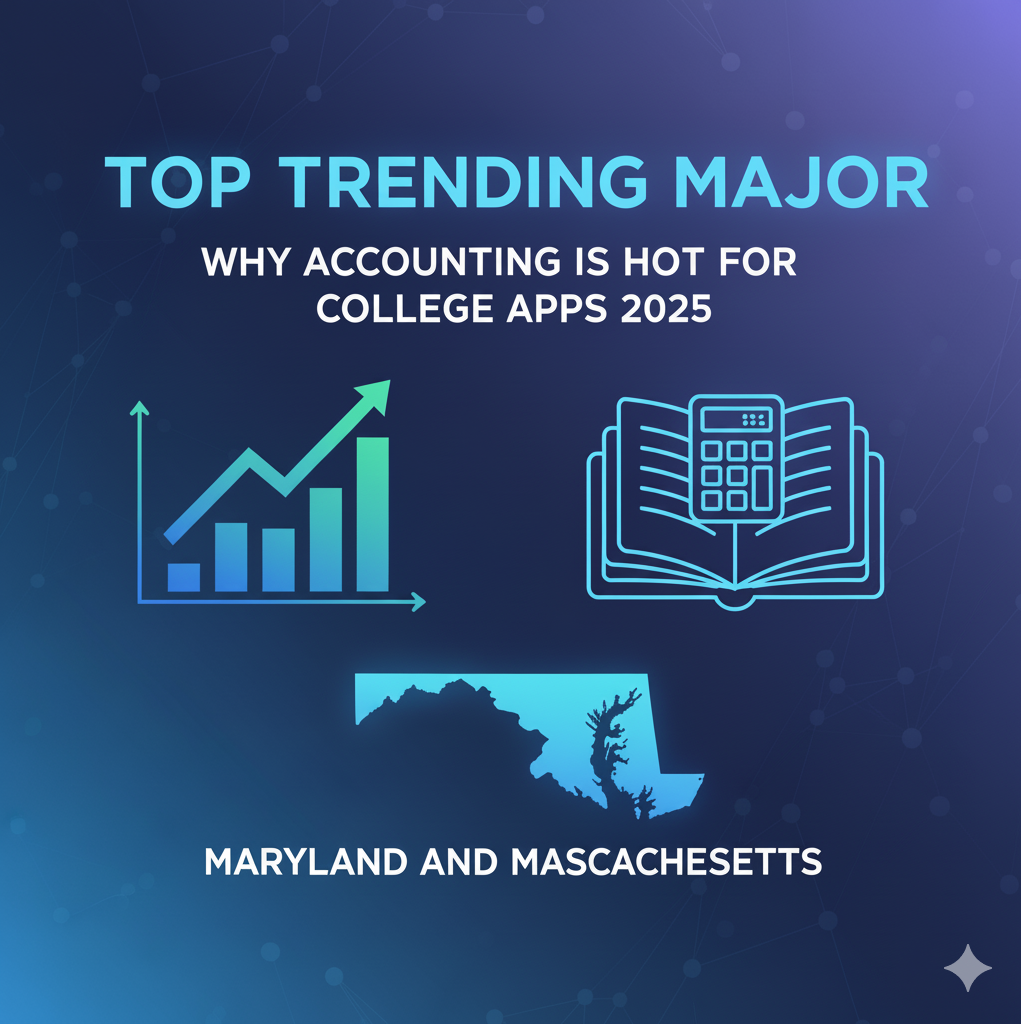
Accounting is the top-trending major searches alongside “college applications” in the past week — especially in Maryland and Massachusetts — because students are choosing stability plus tech-forward career pathways.
Why this matters right now: the combination of a large retirement-driven talent gap, rapid tech adoption in accounting, and Gen Z’s demand for meaningful, flexible careers has pushed Accounting to the top of search interest and applications in 2025. This post “Top Trending Major: Why Accounting Is Hot for College Apps 2025” explains the trend, shows what applicants should do today, and provides actionable tactics for getting accepted and job-ready.
Accounting has surged as the top-trending major for 2025 college applicants (notably in Maryland and Massachusetts) because of a nationwide shortage of accountants, strong placement rates for accounting graduates, and the profession’s rapid shift to data analytics and advisory work. Students who combine accounting fundamentals with analytics (Power BI, Python) and experiential credentials (internships, VITA) will maximize employability and CPA prospects. For college apps, highlight analytical projects, internships, and STEM-designated MAcc pathways.
Why Accounting Is Hot for College Apps 2025
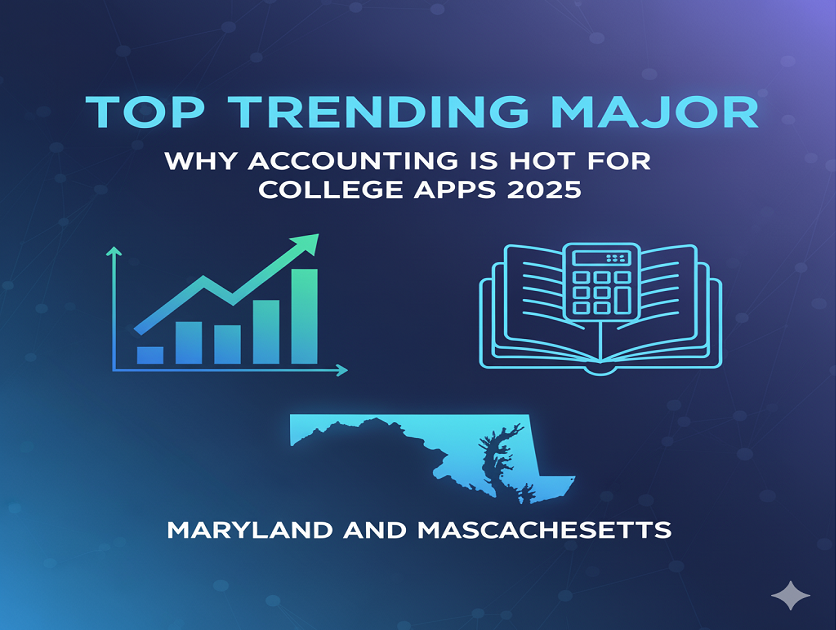
Accounting delivers high employability, high demand, and clear ROI for 2025 applicants.
A nationwide talent shortfall and retiring workforce mean accounting grads enjoy near-certain placement and strong starting salaries.
Employers report large accounting vacancies and universities report high placement rates for accounting majors; CPA-qualified graduates often receive competitive offers. It emphasize CPA-track coursework, internships, and analytics skills in your application to stand out.
Why is accounting trending for college applicants in 2025? — Because of a large talent gap, strong hiring demand, and the profession’s tech-driven transformation.
Maryland and Massachusetts led recent searches for “college applications” with Accounting as the top major.
Local demand and strong business-education ecosystems in these states amplify the national trend.
Schools in MD/MA (large public universities and private colleges with strong business programs) actively promote analytics and internships that feed regional employers.
Applicants from these states should target local internship pipelines, co-ops, and alumni networking to convert search interest into offers.
What’s changed — Accounting is not “boring”; it’s a data-driven strategic career
Modern accounting is data science plus business strategy, not just bookkeeping.
Accountants now use AI, RPA, and analytics tools to deliver advisory insights. Routine reconciliations are automated, while analysis, forecasting, and fraud detection require human judgment and technical skill.
S0, applicants should list projects using Power BI/Tableau, coursework in Python or SQL, and examples of financial modeling.
Why does accounting appeal to Gen Z students in 2025?
Gen Z values a career that is stable, flexible, and purpose-driven — and accounting checks all those boxes with remarkable consistency. In addition to offering long-term job security and strong earning potential, the accounting profession now provides hybrid work environments, competitive compensation, and a renewed sense of purpose rooted in public trust.
Moreover, as modern firms embrace flexibility and inclusivity, many now offer hybrid or fully remote roles, mental-health benefits, and professional development programs that align with Gen Z’s demand for work-life balance. At the same time, the CPA pathway and its ethical standards perfectly match Gen Z’s desire for transparency, accountability, and meaningful impact.
To demonstrate this alignment in college applications or personal statements, students should highlight experiences that blend purpose with professionalism, such as volunteer tax assistance through the VITA program, participation in ESG (Environmental, Social, and Governance) reporting initiatives, or involvement in compliance and audit internships. These examples not only reinforce your understanding of ethical finance but also signal to admissions committees that you view accounting as more than numbers — it’s a profession built on integrity, innovation, and positive social impact.
Is accounting a good major if I like data and tech? — Yes. Accounting now blends financial fundamentals with analytics and technical tools.
The Great Accounting Retirement Wave: How Fewer Professionals Are Creating Massive Job Openings in 2025
A generation of accountants is retiring, creating thousands of open roles. This supply gap gives graduates negotiating power and fast career entry. So, with Baby Boom retirements and less influx into public accounting, job openings have widened across audit, tax, and advisory teams. That’s why students who combine CPA preparation with hands-on internships often secure multiple job interviews and advance more quickly in their careers.
Does accounting offer good work-life balance? — Many corporate accounting roles are flexible; public accounting has busy seasons but strong long-term benefits.
Modern Accounting Pathways: How to Build Your Degree and Profile for 2025 Career Success
How can students design an accounting degree that stands out in 2025?
To succeed in the 2025 job market, future accountants must build degrees that merge analytics, technology, and core accounting principles. Today’s employers aren’t just seeking graduates who understand balance sheets — they want professionals who can interpret financial data, automate processes, and deliver strategic insights.
Start by prioritizing programs that combine accounting fundamentals with modern data tools.
Look for Master of Accountancy (MAcc) or undergraduate programs that offer STEM designation, since these highlight a focus on data science, quantitative reasoning, and analytical decision-making. For international students, STEM-designated MAcc programs also provide valuable OPT (Optional Practical Training) extensions — an additional career advantage in the U.S.
Next, target universities that teach real-world financial technology tools and analytics platforms.
Courses should include hands-on experience with Power BI, Python, SAP, and financial modeling. Programs that emphasize these tools not only improve employability but also demonstrate to recruiters that you’re ready for data-driven accounting, auditing, or advisory work.
Here’s a short checklist to structure your degree and resume for maximum 2025 readiness:
✅ STEM-Designated MAcc? – Choose a program emphasizing analytics and quantitative methods.
✅ Core Courses: Data Analytics, Financial Modeling, and Information Systems.
✅ Technical Tools: Power BI, Tableau, Python, SQL, QuickBooks, and SAP.
✅ Work Experience: Internships, VITA (Volunteer Income Tax Assistance), or applied finance projects.
A 2025-ready accounting degree blends technology, analytical skills, and ethical awareness — the perfect mix to position you as a strategic, data-smart, and trustworthy accounting professional.
Tactical Steps for Accounting Applicants: What to Include in Your 2025 College Application
What should accounting applicants highlight in their 2025 college applications?
Show admissions officers that you already think like a modern accountant — analytical, ethical, and impact-driven. Accounting programs in 2025 value applicants who can merge numbers with narrative: demonstrating both technical ability and professional judgment. By showcasing measurable experience and problem-solving, you prove readiness for a data-driven business world.
1. Lead With Experience That Reflects Analytical Thinking
Admissions committees want evidence that you’ve applied accounting logic to real problems.
Include internships, part-time finance roles, or business club projects that show hands-on familiarity with financial data. Even small projects — like managing a club budget or analyzing event costs — help communicate your analytical mindset.
Example: “Analyzed financial records for a school fundraiser to identify a 15% cost-reduction opportunity.”
2. Connect Accounting Skills to Real-World Impact in Your Essays
Use your personal statement to link accounting to purpose and results.
Discuss how you’ve turned financial data into insights — such as identifying audit gaps, optimizing spending, or reporting sustainability outcomes. This helps admissions officers visualize you as someone who applies numbers ethically and strategically.
Example: “Developed a basic sustainability cost tracker for our eco club, improving transparency in how we managed donations.”
3. Quantify Results to Prove Competence and Initiative
Numbers strengthen credibility — and admissions teams love measurable impact.
Whenever possible, add concrete metrics and specify the tools used to achieve results.
Example: “Reduced reporting time by 30% using an automated spreadsheet built in Excel.”
List key platforms such as Power BI, Excel, or Python, and mention how they helped you visualize or streamline financial information.
4. Include Ethical and Service-Based Experience
Admissions officers value character and community contribution — essential parts of the accounting profession.
Highlight volunteer work like VITA (Volunteer Income Tax Assistance) or any local community finance initiative. These experiences showcase public trust, accuracy, and service — qualities central to the CPA path.
At last, A strong 2025 accounting application doesn’t just list achievements — it tells a story of precision, integrity, and analytical innovation. By combining metrics, technology, and purpose, you position yourself as exactly the kind of future accountant modern firms and universities are eager to develop.
What should I put on my college app if I want to major in accounting? — Internships, VITA, analytics projects, leadership in finance clubs, and clear CPA-track coursework.
Sample Paragraphs You Can Use in Your Accounting Application Essay
How can you write a compelling college essay for an accounting major?
A strong accounting essay blends technical skills with real-world impact. Admissions committees look for applicants who not only understand numbers but can also apply analytical thinking to solve meaningful problems. Use your essay to show how you’ve turned curiosity into contribution.
1. Demonstrate Strategic Problem-Solving Through Experience
“I chose accounting because it blends numbers with strategic problem-solving.”
This opening line immediately signals clarity of purpose and analytical mindset.
During a summer internship, I automated a small-business invoicing spreadsheet, reducing monthly reconciliation time by 40%. This project didn’t just save time — it demonstrated initiative, efficiency, and practical understanding of accounting automation.
✅ Pair quantitative results with the tools used (e.g., Excel macros or Power BI) to show technological fluency and professional readiness.
2. Highlight Ethical and Service-Driven Contributions
“Volunteering with VITA gave me real tax-preparation experience and a sense of community impact.” — Sarah, VITA Volunteer (2024)
Including experiences like VITA (Volunteer Income Tax Assistance) adds authenticity and human connection to your essay. It shows that you value transparency, accuracy, and service — the ethical pillars of the accounting profession.
✅ Admissions officers appreciate applicants who see accounting as more than a career — as a form of public trust.
3. Connect Results to Values and Vision
Every great accounting essay ends with a sense of direction.
You might conclude with a reflection such as:
“These experiences confirmed that accounting is not just about calculations; it’s about creating systems of trust and clarity. I hope to become a CPA who helps businesses and communities make responsible, data-informed decisions.”
✅ End your essay by linking your skills, ethics, and aspirations to the broader mission of accounting.
Voice Tip (for Audio or Video Summary):
🎧 “I’m drawn to accounting because it combines analytical problem-solving with integrity and impact. Through internships and volunteer tax work, I’ve learned that accuracy builds trust — and trust builds stronger communities.”
Career Outcomes: Immediate and Mid-Term Expectations for Accounting Majors
What kind of career outcomes can accounting majors expect after graduation?
Accounting graduates in 2025 can expect rapid job placement, multiple career options, and strong long-term growth. Thanks to a nationwide talent shortage and expanding financial regulations, employers across sectors — from corporate finance to government — are hiring qualified accountants at record speed.
Immediate Outcomes: Fast Placement and High Job Security
Accounting is one of the few majors with near-guaranteed employability.
Most graduates secure jobs within 0–6 months of graduation, especially those who pursue internships or CPA-track coursework. Entry-level positions include audit associate, tax analyst, or staff accountant roles, each offering a strong foundation for upward mobility.
Note:- Universities report placement rates as high as 98% for accounting graduates.
✅ Core takeaway: Leverage internships, campus recruiting, and professional networks early — employers value proactive candidates who can demonstrate applied accounting skills.
Mid-Term Outlook: CPA Licensure and Analytics Skills Accelerate Career Growth
Within two to five years, accounting professionals often advance into senior or advisory positions, especially if they earn CPA certification.
The CPA remains the industry’s gold standard, enhancing credibility, salary potential, and leadership opportunities. At the same time, proficiency in data analytics tools like Power BI, Tableau, or Python opens access to emerging roles in FP&A (Financial Planning & Analysis), forensic accounting, and risk advisory.
✅ Combine CPA preparation with analytics expertise to future-proof your accounting career in the data-driven economy.
Diverse Career Pathways: Flexibility Across Every Industry
Accounting is not limited to auditing and taxes — it’s a launchpad for multiple professional directions.
Graduates move into public accounting firms, corporate finance departments, consulting agencies, government organizations, or tech startups, applying their expertise to budgeting, financial strategy, and compliance.
Example: Accountants with FP&A or data science backgrounds are now being recruited by Fortune 500 companies for hybrid finance-analytics roles.
✅ A degree in accounting offers unmatched flexibility — once you master financial logic and data storytelling, you can pivot into almost any business discipline.
Quick Career Snapshot
| Career Stage | Focus Area | Typical Role(s) | Timeline |
|---|---|---|---|
| Entry-Level | Audit, Tax, Reporting | Audit Associate, Staff Accountant | 0–6 months post-grad |
| Early Career | CPA + Analytics | FP&A Analyst, Risk Advisor, Consultant | 1–3 years |
| Mid-Career | Leadership & Strategy | Financial Manager, Controller, Advisory Partner | 4–7 years |
✅ Important Point: The accounting profession rewards consistency and credentialing — pairing technical knowledge with ethical and analytical excellence guarantees career advancement.
Accounting majors entering the workforce in 2025 face one of the strongest job markets in decades. With CPA licensure, data analytics fluency, and ethical awareness, graduates can secure not just jobs — but careers that evolve into leadership and advisory roles at the core of business decision-making.
How to Build Credibility (E-E-A-T) in Your Profile and College Application
How can applicants demonstrate experience, expertise, authoritativeness, and trustworthiness (E-E-A-T) in accounting applications?
In 2025, college admissions and recruiters increasingly value applicants who show E-E-A-T — Experience, Expertise, Authoritativeness, and Trustworthiness. For accounting majors, this means moving beyond grades to prove real-world financial competence, ethical awareness, and leadership through verified experience.
1. Show Your Experience with Measurable Projects and Credentials
Start by highlighting quantifiable, supervised experiences that prove your technical and ethical grounding.
List specific projects, certifications, and internships — for example, preparing tax statements under supervision or completing an online accounting analytics course. Use action-oriented, metric-based phrasing like “audited 50+ entries for accuracy” or “reconciled monthly budgets using Excel automation.”
✅ Key Insight: Measurable outcomes and supervisor oversight increase the perceived authenticity of your achievements.
2. Strengthen Authoritativeness with Endorsements and Testimonials
Admissions officers and employers trust verified perspectives.
Whenever possible, include faculty endorsements, internship supervisor quotes, or mentor recommendations that validate your performance. Even a short testimonial like “Deepak demonstrated exceptional precision in financial reconciliation tasks,” gives credibility to your claims.
✅ Key Insight: Endorsements act as third-party verification, establishing authority and reliability.
3. Enhance Trust with Transparent, Publicly Visible Work
If permitted, share links to public projects, competition results, or published case studies that showcase your analytical and ethical standards. Mention your LinkedIn profile or a digital portfolio where recruiters or admission officers can verify your work. Add faculty or supervisor quotes in your LinkedIn Recommendations section to amplify credibility.
✅ Important Aspects: Transparency and public validation directly increase trust — the “T” in E-E-A-T.
E-E-A-T Boosters for Accounting Applicants
| E-E-A-T Element | How to Demonstrate It | Example or Action Step |
|---|---|---|
| Experience | Hands-on projects & internships | Volunteer tax work, audit simulations |
| Expertise | Certifications & coursework | Accounting Analytics, Excel, Power BI |
| Authoritativeness | Faculty or supervisor quotes | Include brief endorsement in essays |
| Trustworthiness | Public portfolio or LinkedIn | Publish verified projects or metrics |
✅ Key Insight: E-E-A-T isn’t about buzzwords — it’s about provable actions, measurable results, and verified endorsements that show integrity and competence.
To stand out in your 2025 accounting college application, show what you’ve done, who can vouch for it, and how it reflects your ethics and expertise. Demonstrating E-E-A-T builds immediate credibility — the cornerstone of success in both academics and the accounting profession.
I’ve jotted down some sample essay examples — let’s check them out!
College Essay — “Why I Chose Accounting as My Major”
Accounting appeals to me because it blends logic with impact — numbers that tell a story, data that drives decisions, and ethics that sustain trust. Growing up during a time of financial uncertainty taught me the value of clarity and accountability in business. That’s why I want to major in Accounting — a discipline that transforms complexity into confidence and transparency.
During high school, I developed my analytical skills through business club competitions and by managing our team’s expense tracker. I discovered that I genuinely enjoy analyzing financial patterns and solving budget discrepancies. To deepen this interest, I volunteered with the Volunteer Income Tax Assistance (VITA) program, helping low-income families file returns. The experience showed me how accounting directly supports communities — translating technical skills into real-world impact. It also strengthened my sense of ethical responsibility, a core principle I intend to carry into my future CPA career.
Beyond financial reporting, I’m fascinated by how technology is reshaping the profession. I’ve completed online courses in Excel automation, Power BI, and basic Python for accounting, understanding how data analytics enhances decision-making and fraud detection. I hope to study in a program that emphasizes STEM-designated accounting and integrates analytics and advisory skills.
Ultimately, I see myself becoming a strategic business advisor — someone who not only interprets financial data but also guides organizations toward sustainable, ethical growth. Accounting isn’t just about numbers for me; it’s about clarity, trust, and leadership. Choosing this major means choosing a career that balances purpose, precision, and progress — values I’m proud to pursue.
Boston College Essay — “Why I’m Choosing Accounting as My Major”
I’m drawn to accounting because it stands at the intersection of numbers, integrity, and impact — three values that define how I want to live and lead. Growing up during an era of financial instability made me realize that behind every strong organization is a foundation of transparency and trust. That’s why I want to study accounting — not just to master financial principles, but to help build confidence in how businesses serve society.
In high school, I managed our business club’s annual budget, where balancing expenses taught me both precision and accountability. My interest deepened when I joined the Volunteer Income Tax Assistance (VITA) program, helping families prepare tax returns. Seeing the relief on their faces after filing accurately reminded me that accounting isn’t just about ledgers — it’s about people. It also reinforced my commitment to ethical practice, a cornerstone of the Certified Public Accountant (CPA) path I plan to pursue.
Boston College’s Carroll School of Management excites me because it blends traditional accounting rigor with modern analytical insight. Courses in Data Analytics for Accountants and the Accounting Information Systems Lab will allow me to pair financial logic with technology — from Power BI to Python-driven analysis. I’m particularly inspired by BC’s Jesuit emphasis on service and leadership, which mirrors my belief that ethical accounting strengthens communities.
In the future, I see myself as a strategic advisor who uses data and integrity to guide responsible growth. Choosing accounting at Boston College isn’t just an academic decision; it’s a step toward becoming the kind of professional who turns numbers into trust — and knowledge into purpose.
🏁 Closing Core Sentence: Accounting Is a High-Opportunity, Modern, and Strategic Major for the Class of 2025
Why is accounting considered one of the smartest degree choices in 2025?
Accounting stands out in 2025 as a high-opportunity and future-proof major, blending stability, technology, and strategy. It’s not just about managing numbers — it’s about interpreting data, ensuring transparency, and driving smarter business decisions in an AI-driven economy.
To capitalize on this growing trend, applicants should focus on building a well-rounded, data-savvy profile. Choose programs that integrate analytics, financial technology, and real-world accounting applications. This approach signals readiness for the modern workplace and aligns perfectly with what employers are seeking today.
Strengthen your profile with internships and service-based experiences such as the Volunteer Income Tax Assistance (VITA) program, where you can apply classroom knowledge to community impact. Complement these with hands-on analytics tools like Power BI, Excel, or Python, and always quantify your results — for instance, “Improved reporting accuracy by 20% through automated data validation.”
✅ Key Insight: The combination of analytical skills, practical experience, and ethical engagement makes accounting not just a safe choice — but a strategic career investment for the class of 2025 and beyond.
Conclusion on Why Accounting Is Hot for College Apps 2025
Accounting has emerged as a top-trending major for the class of 2025, offering students unmatched career stability, global demand, and high earning potential. With a growing shortage of qualified professionals, accounting graduates equipped with data analytics, CPA credentials, and ethical experience are in prime position to succeed. Choosing programs that emphasize technology, internships, and measurable impact ensures students not only secure jobs quickly but also build long-term, purpose-driven careers in finance, auditing, and advisory roles.
Related:-
The Overlooked Ways to Learn That Will Define Future Success