
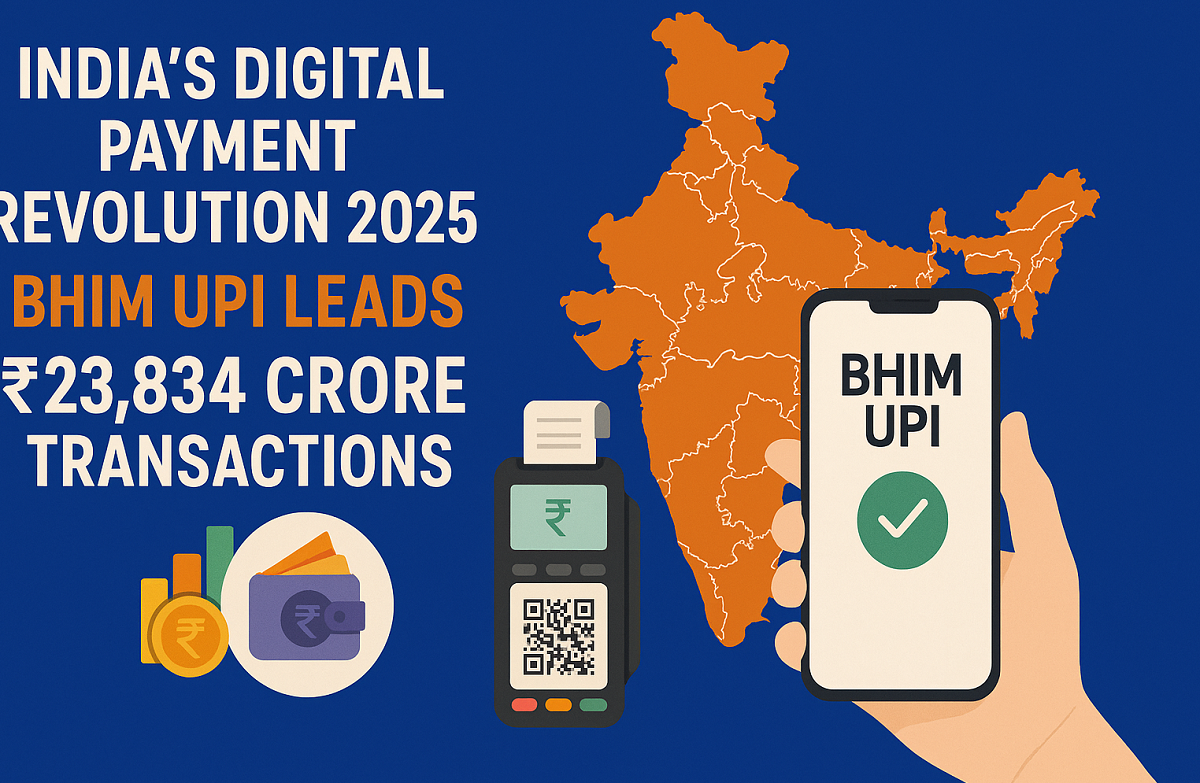
India’s digital payment ecosystem has become the largest and fastest-growing in the world, crossing ₹23,834 crore transactions in FY 2023–24 according to the DigiDhan Dashboard (MeitY). By October 2025, the total for FY 2024–25 had already reached ₹12,594 crore, showing that India’s digital-first economy is expanding faster than any traditional banking system ever did.
The surge reflects not just urban convenience but a nationwide adoption of BHIM UPI, Aadhaar Pay, and mobile banking, integrating every citizen — from street vendors to salaried professionals — into the formal financial system.
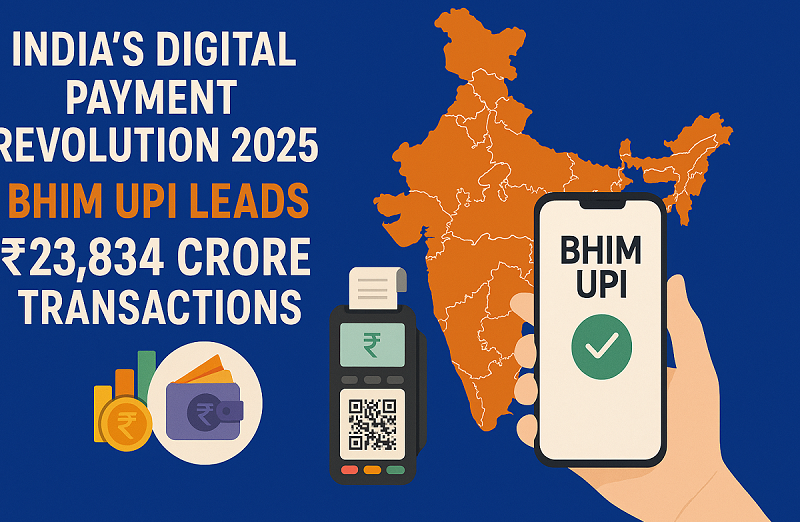
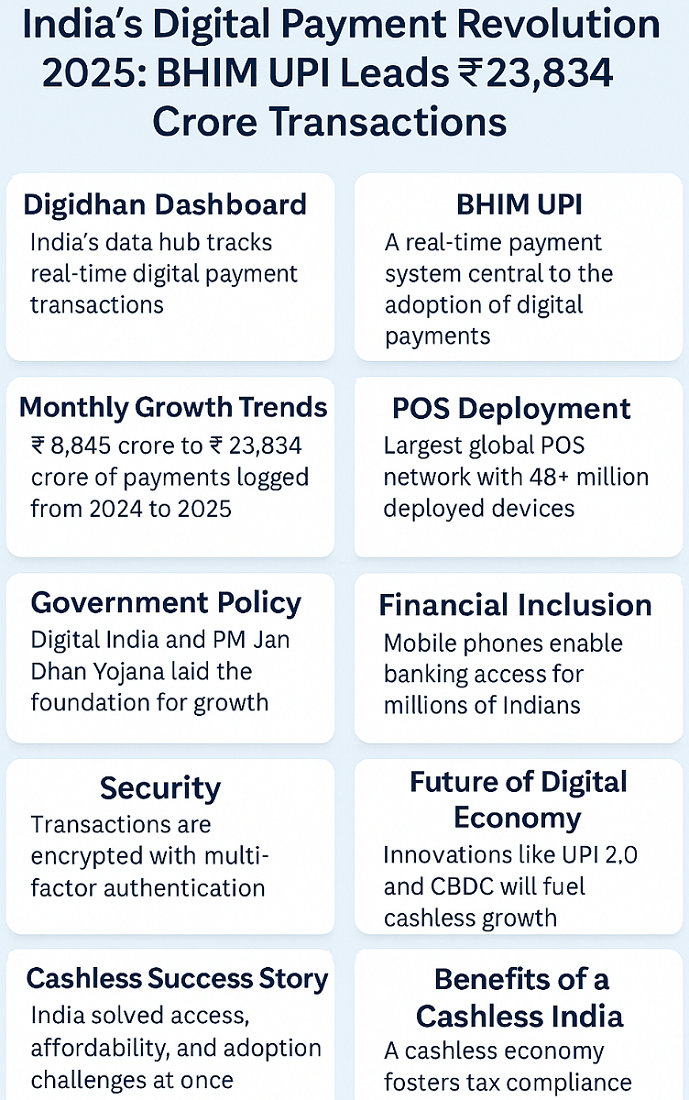
India’s Digital Payment Revolution 2025: BHIM UPI Leads ₹23,834 Crore Transactions
How has the volume of digital payments evolved since 2021?
India’s digital transactions have grown nearly threefold — from ₹8,845.79 crore in FY 2021–22 to ₹23,834 crore by 2023–24.
This growth is captured in real time by the DigiDhan Dashboard, which compiles data from RBI, NPCI, and Indian banks across 16 payment modes including BHIM UPI, NEFT, RTGS, IMPS, PPI, debit/credit cards, and Internet banking.
Core insight: BHIM UPI now dominates the chart, representing more than half of all digital transactions in India. This single platform has revolutionized payments through speed, simplicity, and smartphone integration.
Why is BHIM UPI considered the backbone of Digital India?
Because BHIM UPI has made cashless payments universal and instant, transforming India into a digital-first economy.
Built by NPCI (National Payments Corporation of India), UPI enables anyone with a smartphone and a bank account to transfer money instantly using just a mobile number or QR code, 24×7.
Users no longer need to remember IFSC codes or account numbers. With QR codes displayed even in small shops, UPI’s reach has spread from corporate offices to rural kirana stores — fulfilling the promise of financial inclusion under the Digital India mission.
How much does India rely on BHIM UPI every month?
Every month, India records 1.5–1.8 lakh crore UPI transactions, according to government data for 2024–25.
This consistency in transaction volume shows how digital payments have replaced cash as India’s everyday medium of exchange.
Sample monthly data (Oct 2024–Sept 2025):
- Jan 2025: 1.69 lakh crore
- Mar 2025: 1.83 lakh crore
- Jul 2025: 1.83 lakh crore
The pattern is clear — digital payments are no longer seasonal or festival-driven; they’re part of everyday life.
How big is India’s digital payment infrastructure?
India has one of the largest Point of Sale (POS) networks in the world.
The Digidhan Dashboard reports:
- 33,69,23,596 Physical/Mobile POS devices
- 14,92,063 BHIM Aadhaar Pay POS machines
This infrastructure ensures that even rural merchants and small-scale sellers can accept UPI and Aadhaar-based transactions seamlessly. In practical terms, this network means digital payment acceptance is within reach of every Indian citizen, bridging urban–rural divides.
What policies made this growth possible?
Government policies like Digital India, PM Jan Dhan Yojana, and Direct Benefit Transfer (DBT) are the foundation of India’s digital economy.
Together with RBI and NPCI, they created a secure, interoperable environment where transactions are real-time, low-cost, and inclusive.
This ecosystem ensures that even welfare payments — pensions, subsidies, or scholarships — can be credited directly to citizens’ accounts, reducing leakages and corruption.
It’s a model of governance through fintech, admired globally.
How does BHIM UPI drive financial inclusion?
BHIM UPI has turned mobile phones into mini banks for millions of Indians.
Through apps like PhonePe, Google Pay, Paytm, Amazon Pay, and the official BHIM app, users can send and receive money, pay bills, or scan QR codes — all without visiting a branch.
Even those without smartphones benefit through BHIM Aadhaar Pay, which allows merchants to accept payments authenticated via Aadhaar and fingerprint.
This is why policymakers describe UPI as “digital money that empowers the poor.”
Is digital payment in India secure and reliable?
Yes — India’s digital transaction framework is built with bank-grade encryption and multi-layer authentication.
UPI, NEFT, and IMPS systems are protected under RBI-regulated cyber laws and NPCI’s fraud detection networks.
Security measures include:
- Two-factor authentication (PIN + device binding)
- Real-time transaction monitoring
- OTP-based authorization
- 24×7 complaint redressal via banks and apps
Consumers also receive instant alerts for every debit or credit — increasing transparency and trust.
What’s next for India’s digital economy?
The future of India’s payments ecosystem points toward UPI 2.0, UPI Lite, and CBDC (Digital Rupee).
These next-generation innovations will make payments even faster, offline-ready, and globally accepted.
In addition, cross-border UPI linkages with Singapore (PayNow), UAE, and France are expanding India’s influence in the global fintech landscape.
As per MeitY projections, India’s digital economy could exceed $2 trillion by 2030, led by payments, data, and financial services.
Why do experts call India a “cashless success story”?
Because India solved three challenges at once — access, affordability, and adoption.
With zero-charge UPI transfers, massive smartphone penetration, and government-supported awareness, India became a model for how to digitize finance at scale.
In contrast to many countries where digital payments grew organically, India’s rise was policy-led and infrastructure-driven, ensuring inclusive access for both citizens and small businesses.
What are the benefits of a cashless India?
A cashless system strengthens the economy by making transactions traceable, transparent, and tax-compliant.
It reduces the cost of printing, distributing, and managing physical cash while boosting financial literacy and accountability.
For the government, it means better targeting of welfare schemes through DBT.
For citizens, it offers speed, convenience, and control over their finances — all in the palm of their hand.
Key Takeaways On India’s Digital Payment Revolution 2025: BHIM UPI Leads ₹23,834 Crore Transactions
- Digital transaction volume: ₹23,834 crore (FY 2023–24)
- FY 2024–25 progress: ₹12,594 crore by Oct 2025
- Top mode: BHIM UPI (over 50% share)
- POS deployment: 33 crore+ physical/mobile units
- Vision: Empower every Indian through secure, inclusive, and instant digital payments
India’s digital journey proves that when technology meets inclusion, progress accelerates — and the results speak for themselves.
💬 Have a thought to share? Comment below!
🔔 Like what you read? Subscribe for weekly updates on India’s digital revolution!
Disclaimer:
This article is for educational purposes only and not financial advice. For personal financial guidance, please consult a licensed professional.
You may like to read:-
What Are Digital Skills? A Beginner’s Guide for Students and Professionals
Frequently Asked Questions
BHIM UPI is leading India’s digital payments — but what makes it so dominant?
The strength of BHIM UPI lies in its simplicity and inclusivity. It connects multiple bank accounts under one app and allows instant, zero-cost transfers across users and merchants. In 2025, the combination of government trust, massive user adoption, and merchant accessibility helped UPI achieve an unmatched transaction volume of ₹23,834 crore.
India’s digital payments exploded in 2025 — how did this transformation happen so fast?
This growth didn’t happen overnight. Affordable data plans, wider smartphone reach, and government incentives created a perfect environment for digital adoption. Apps like PhonePe, Google Pay, and Paytm integrated UPI deeply into daily life, turning every mobile phone into a mini bank.
Security remains a major concern — is UPI really safe for such large transactions?
Yes, UPI transactions are among the most secure globally. Every payment is verified using a UPI PIN, while the NPCI’s backend uses advanced encryption and real-time fraud detection systems. Continuous upgrades in AI-based monitoring ensure your money stays protected, even during peak transaction hours.
Small businesses are thriving with UPI — but how exactly are they benefiting?
UPI has empowered local shopkeepers, street vendors, and service providers like never before. With no setup cost and zero MDR for small transactions, even micro-merchants can accept digital payments instantly. It has eliminated the need for POS machines and encouraged cashless convenience in rural and semi-urban areas.
India’s payment future looks bright — what’s next after the 2025 milestone?
The next phase is all about global expansion and innovation. Cross-border UPI payments with nations like Singapore, UAE, and Nepal are already live. Soon, voice-enabled and AI-driven payment features will redefine convenience, making India’s fintech ecosystem a global benchmark for digital transformation.





Almost all of whatever you claim is supprisingly precise and it makes me wonder the reason why I had not looked at this in this light before. Your piece truly did turn the light on for me as far as this particular topic goes. However there is one factor I am not too comfy with so whilst I make an effort to reconcile that with the central theme of the point, permit me observe just what all the rest of your subscribers have to point out.Very well done.